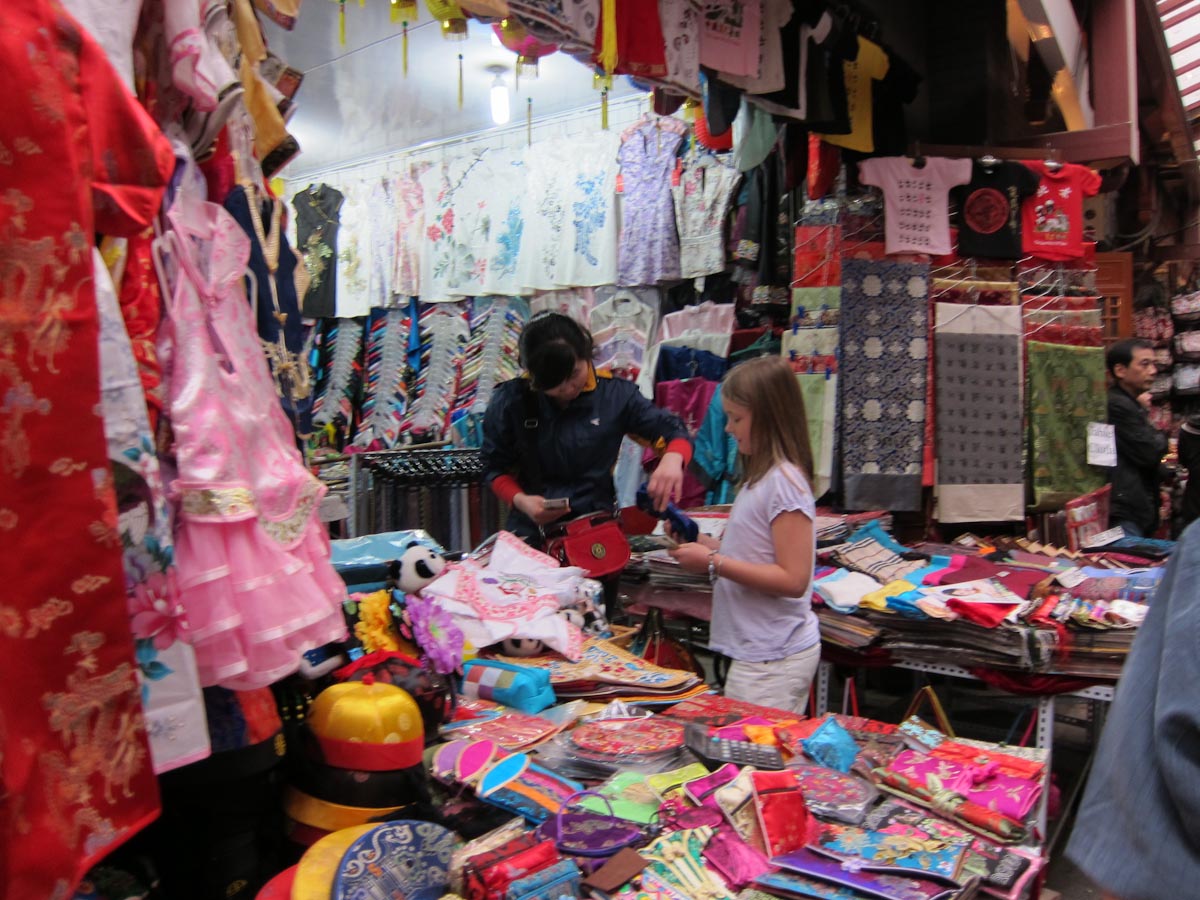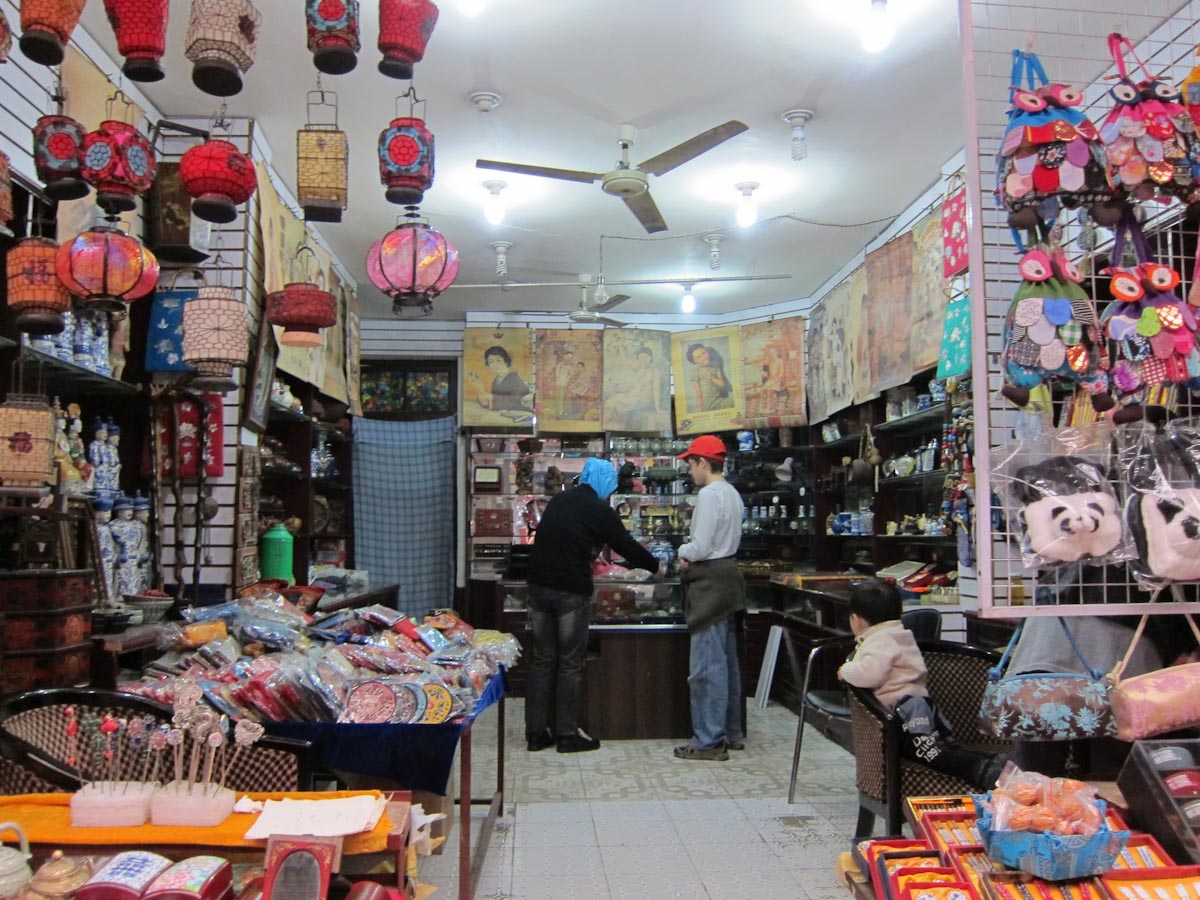
During our travels we’ve shopped many a tourist stand and we hereby award a prize to the merchants of Yongshuo in the Guilin region. They are the most rapacious we have met so far! Another prize goes to the curio dealers of Xi’an. As our guide Gerard explained, they have a wide range of yesterday’s antiques. These folks are some of the most subtle.
We thought we would share a collection of tactics that we have encountered from merchants. Being aware of these may help you not to be taken.
The Approach
In some places, a throng of salespeople wait in the parking lot or by the dropoff point and crowd you the moment you get out of your van.
– A child will hold up postcards or tug on your sleeve.
– An old woman with a very heavy basket laboriously staggers over to you.
– A smiling handsome young man who will walk over and chat warmly in excellent English.
The basest form of vendor appeal is to howl “Hello! Hello!” from their stands, the way a businessman late for the airport would shout for a Manhattan taxi. They sound like they are standing on hot coals and in desperate pain. Once you make eye contact, they run over and cajole you to look at their stand. It is hard not to look at someone shouting this way.
Another form of this is to hold something up and shout out “One dollar!” in English. Wow that’s too good to be true, you think. Again, once you look, they completely forget this number and just follow you around.
And if that does not work, why not resort to mind-control: “You look! You look!” It turns out we all have a deep-seated reflex to look, when someone shouts look.
A variation to the above is for an object that you expect should cost about 100 yuan. The vendor sees you and yells out “Watch for 30!” Now that’s a bargain – $4 for a watch! You don’t need one but you guess maybe you have a friend who would like that so why not? After a few minutes careful selection to find a handsome model, you pull out 30 yuan. “No no! 30 dollars!”
The second line of the conversation is usually “Where are you from?” and if you reply the third line is “Where are you staying?” The goal here is to get you talking, and build rapport. They want to know your origin and especially your class of hotel, so they can decide the price to charge. If you actually want to buy something and you are sleeping at the Ritz, you will doubtless pay too much. I struggled with how to reply truthfully without giving away bargaining advantage and finally came up with rapidly saying the initials of the hotel, or simple an evasive “somewhere downtown” in rapid English. That usually got an eye blink and then we moved on to discuss the item.
Another tactic is that after they shout and you walk by, they say “you come back on the way out, OK?” If you make even the slightest eye contact, they will be waiting.
The most aggressive vendors will give you a free gift such as a ribbon as you go into a site. You are then marked, and all the other vendors stay away. On your way out the vendor comes over to remind you about the gift and becomes more and more aggressive, until you buy something.
We were particularly impressed by the dedication of the vendors in Guilin, particularly the grandmothers. One lady met us in the parking lot as we set off to hike up a Karst hill, the height of a 40-story building. She wanted to sell us water or beer. When we declined, she fell in with our group and hiked along with us! She kept asking us questions in pidgin English that we could hardly ignore. After about twenty minutes of that, she hoisted her water cooler– which must have weighed 30 pounds at least – from her hip and shook it toward me. “It’s more expensive when we get to the top you know!” Our guide finally bought a bottle of water from her – “Otherwise she will never leave us alone.”
Also in Guilin we took a bicycle ride through the local villages and fields. Two grandmothers saw us ride by and started running after us with postcards and water bottles to sell. We politely said no and kept riding. A while later we slowed down to figure out an intersection. From behind we heard footsteps and yelling– those same ladies were running after us shouting “Hello! Hello!” We kept riding. Ten minutes later the fields opened up to a marvelous view. We had stopped just a moment to take pictures when suddenly a motorscooter (!) pulled up and the first grandmother jumped off the back where she had hitched a ride. She rushed over and started hitting Gina! It turns out she was selling a back massager that looked a bit like salad tongs with wooden knobs on the end. It’s supposed to be soothing. Two minutes later, the second grandmother staggered into view; she had run the whole way on foot. Feeling ashamed at our indifference in the face of their desperation, we paid them $3 for a picture.
The best tactics to resist these approaches are to stay silent, keep eyes ahead and walk purposefully. If the inquiries really bother you and there are many people flocking around, then just buy one of the most common souvenirs and hold it in front of you like a dowsing wand. All vendors of the same item then sadly walk away and the others tend to give up easier because they know you already stopped in someone’s shop.
The Haggle
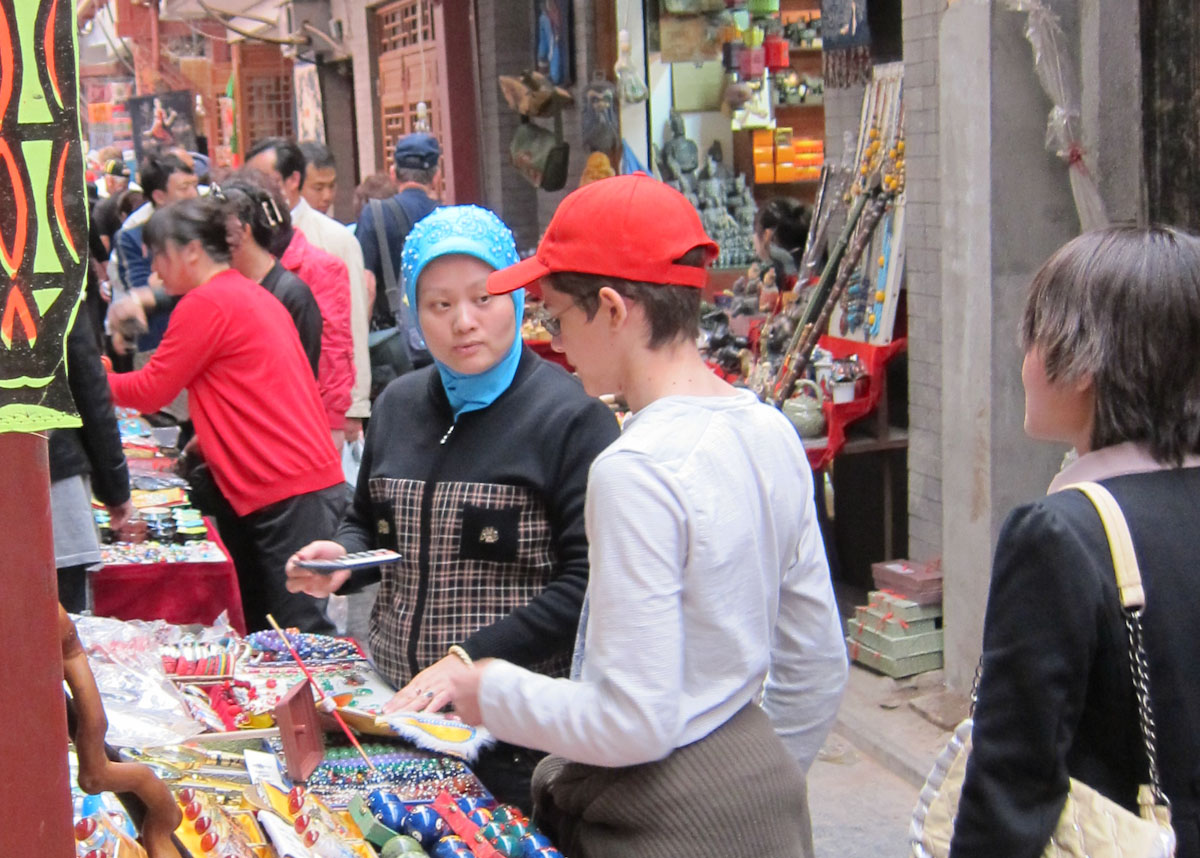
Once you have engaged with the merchant and actually seen something you want to buy, the haggling begins. Carter talked in detail about the price negotiation once the calculator comes out. The opening salvo in this exchange is often the vendor saying “Good price for you! Good price! Special price!” What amazes me is that no matter how many times you hear this patently false claim, it somehow still works to make you more relaxed and open to hear their opening number.
In China, the open number is sometimes as much as ten times the value the merchant will accept. We had heard this rule of thumb from our friend Mei-mei and also our friend Brenda, and had come close to that in several stores where we could achieve about a 70% discount. Then in Guilin we discovered a “jade outlet with no haggling”, where there were hundreds of small jewelry items with preprinted prices on the packages from 100-1500 yuan ($15-$200), but the salespeople literally said we could simply ignore the right-hand zero, bringing the actual they would accept to $1.50 to $20.
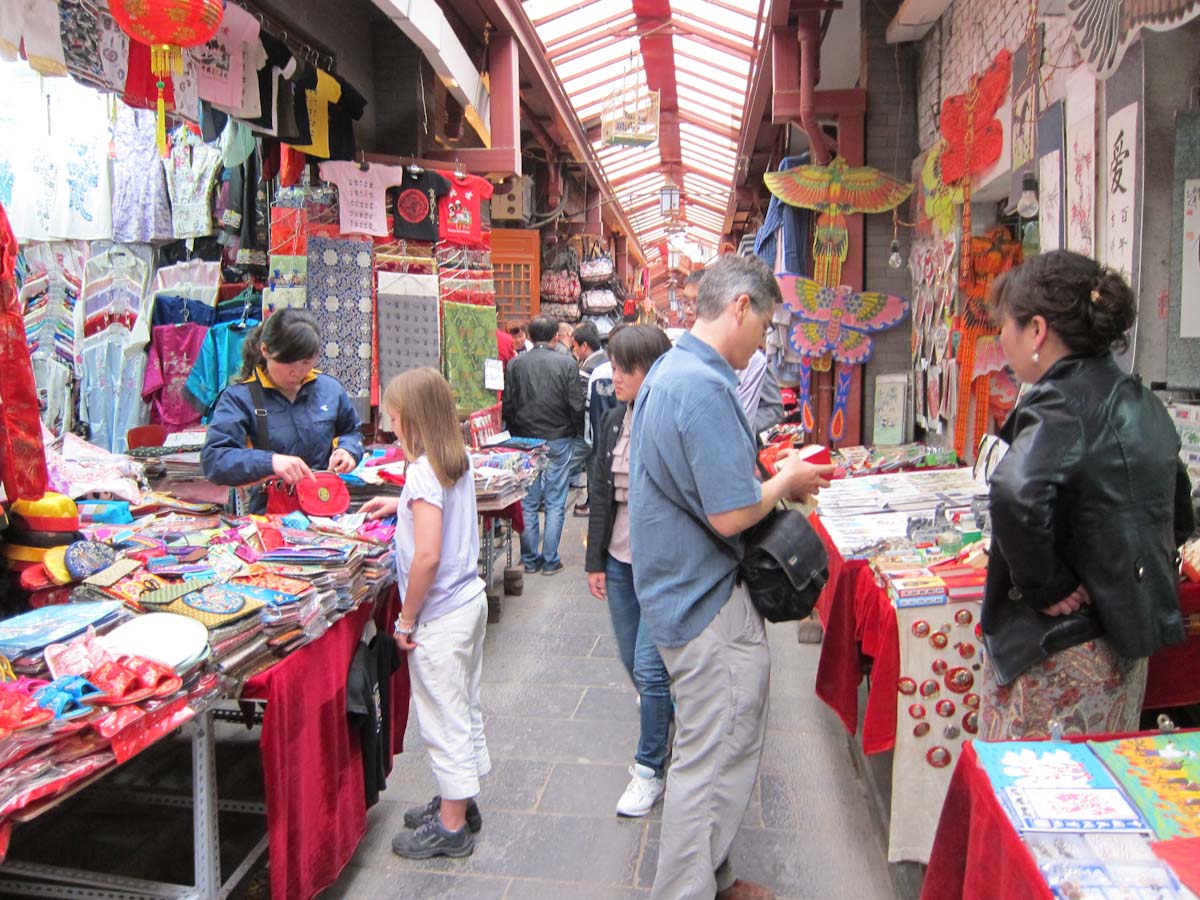
Here are more examples from Xi’an. A man walks up with a box set containing four terra cotta soldiers. He is likely a farmer who has poured local clay into a crude mold and then baked the figures in his backyard. “Just 10 yuan!” Carter wants these so Gina says “OK.” Crafty farmer pulls all four figures out of the box, “Which one you want?” Gina “Didn’t you say ten yuan for the box??” Farmer “Box has four figures. Forty yuan!!” Gina walks away. “OK OK OK. Twenty yuan, whole box!”
T-shirt store… T-shirt out front is prominently priced at 20 yuan but it has a bad design so you don’t want that exact one. So you walk in and find a good design you really like. “95 yuan!” Why? “That T-shirt has bad cotton. This T-shirt nice cotton!” Both are labeled 100% cotton, but there is definitely a different feel. The one you want can be had for 30 yuan if you are patient and indifferent, or 50 yuan if they can tell you really like the new design.
There are lots of jades in China but some of them are simply green glass and they all have varying quality levels. We wanted a small jade circle – the symbol of Heaven – and spotted a nice display case. “Could I see the the jade circles?” The lady pulls out every jade circle EXCEPT ONE to show us. When we point to the remaining one that looks so nice she says “Oh… THAT is a special one.” She is very reluctant to sell it, except at a much higher price.
A variation of this approach is the store that only has 1 unit in stock for each item in inventory. For example, only 1 mask of that demigod you admire. If you express interest, “Last one!” This is also a tactic to make you accept an item with a slight scratch or dent “We only one!”
Going against you in all these transactions is that you have limited time to see alternate vendors and limited information about the local scams (often using bad materials instead of genuine ones, or making reproductions and claiming they are old). Going for you is that if you want basic souvenirs, the same items are frequently sold at multiple shops. In that case you can comparison shop, but you have to be willing to invest the energy to haggle fiercely and walk away at least once to find the bottom.
Currency Exchange
Tourist shops all over the world have a skim where they charge your credit card in US dollars. The rate is calculated based on their internal exchange rates, which are worse than the market rate. The credit cards have even gotten into the act – if the vendors charge you in local currency, the credit card company which add on 2% foreign exchange fee. (One exception is the Premier card from HSBC so we made sure to get that card before starting on our trip – they do not charge a foreign exchange fee.) A good hotel will actually ask you “Would you like us to charge in local currency or dollars?” so you can decide about this.
In Guilin when we checked out the hotel not only preemptively charged us in dollars, but when we said we wanted to be charged in yuan they actually looked us in the face and maintained it was impossible! We finally showed them a copy of an earlier receipt where they had already charged us in yuan. They begrudgingly switched the currency. We found out their fee is an outrageous 8% of the bill!
Hotel Tricks
Some traditional tactics for hiking our hotel bill are super-high charges for using the phone or Internet and high prices on minibar items. We experienced a few more. The bottom line is that you have to check your bill carefully.
We generally booked two rooms with breakfast included. Coming downstairs to breakfast, the server would ask which room? Sometimes if we gave just one of the room numbers, we would discover a bill for two breakfasts on our bill. The hotel had conveniently overlooked the breakfast payments we had made on the other room. Now we are always very careful to say both room numbers.
Another trick is to give two small free water bottles in the bathroom, but if you take a third water bottle from the bedroom it is an expensive minibar item. These are usually a different brand but sometimes packaged to look quite similar.
We have also run into hotel guides in the room that list the inventory of every item in exhaustive detail, showing exorbitant prices for each. You get the impression they *want* someone to take something. We never minded this since we never intended to take anything.
In Guilin we discovered a mysterious 30-yuan charge on the bill – that’s just $4 in US currency but in China it feels more like $20 would in the USA. Gina pursued it. “What is this?” “Charge for glass.” We scratched our heads. Suddenly we realized that when we had put the dirty dishes from a room service meal into the hallway for collection (we asked them to come collect it in the room but they could not understand our English), we must have put out one of the glasses from the room that we had used for drinking a soda. We explained this but the clerk did not seem too happy with us disputing the charge because he did not trust our explanation. “That different department. You want to wait for us to check?” “Yes we wait.” Lots of calling in Chinese and five minutes go by. Are they testing our resolve to quibble? Another day we might feel rushed, but with an evening flight we have time to stand on principle. We just watch. Finally… “OK we have the glass.”
The moral of this story? Be careful with anyone who never expects to see you again. And keep your hand on your wallet in lovely Guilin.