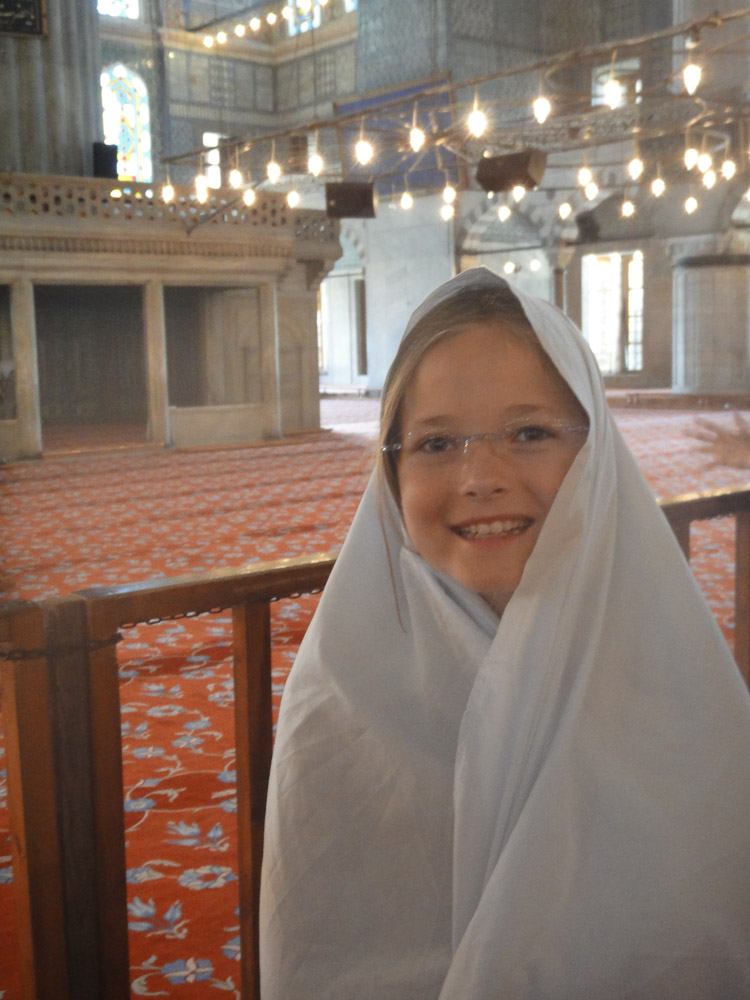
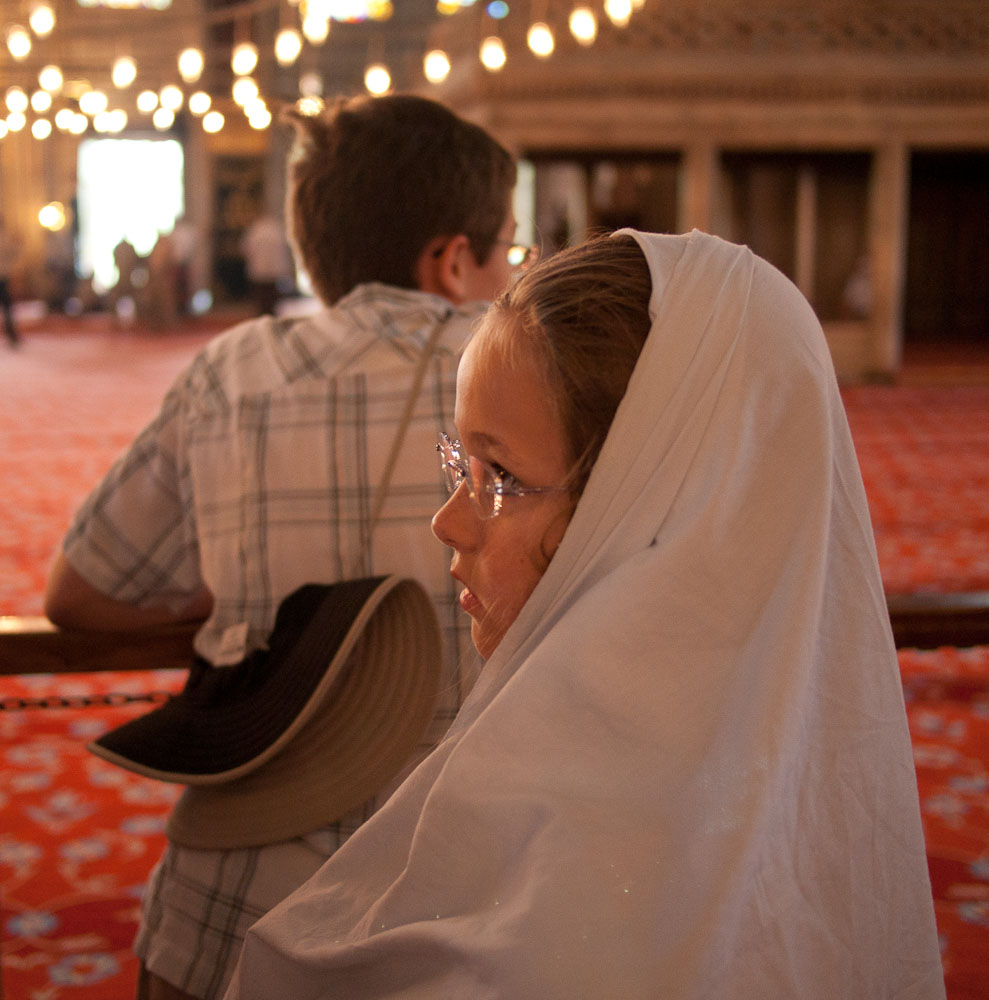
One of the topics in Road School is comparative religion. We wanted to study this because religion has such a great influence on history and culture. Although the book we are using starts with Judaism and Christianity before getting to Islam (and then five more religions), we started with Islam so the kids could have a chance to understand what they were seeing in Turkey.
The lesson came alive instantly when we reached Istanbul because the Empress Zoe hotel is near several mosques. The call to prayer echoes through the hotel at dawn, at noon, in the evening… five times a day! (After we visited the Grand Bazaar – see separate post – we climbed to a rooftop where we were surrounded by mosques and heard the evening call from all directions at once. Listen to an extract of Carter’s recording here: The Evening Call in Istanbul. Our guide explained this is the sound of over 30 mosques – in most of Instanbul you would only be hearing a few of these not all of them.)
We were quite curious then to visit the Blue Mosque, one of the most famous mosques in the world. We listened carefully to our guide’s explanations. As the mid-day services started, they asked all the non-believers to leave. Would we like to come back the next day to stay and observe? Of course! Our guide Serdar was able to obtain permission.
Our background reading had told us that Islam started when the prophet Mohammed living in Mecca started sharing visions he had received around 570AD. He lived in an area that worshipped idols. After experiencing visions in caves near Mecca, he preached that there is only one God (Allah).
The deepest origins go back to Abraham and the story of Abraham’s servant Hagar with whom he had a son named Ishmael. After marrying Sarah (the start of Judaism) he sent Hagar and Ishmael into the desert. They were close to death when a spring rose up in Mecca and saved them. Abraham later returned to Mecca and built a giant cube there placing a stone inside that was given to him by an angel.
Mohammed was persecuted for his teachings by the Meccan authorities. He and his followers were accepted in neighboring Medina and he became the leader there. He later came back and conquered Mecca by force. They kept expanding and by 630AD he controlled most of the Arabian peninsula. After his death there were a succession of Caliphs who expanded the empire while leading the religion, and we will leave the rest of the history – including the split into Sunni, Shiia and Sufi branches – for some other time.
The five pillars of Islam across all branches are: declaring faith in Allah, praying toward Mecca at the appointed times each day, giving alms to the poor, a month of fasting each year, and a pilgrimage to Mecca each year. All mosques are built to face toward Mecca. Upon death, the grave points to Mecca.
Today about 20% of the world population is following Islam and the followers include many races not just Arabian. The Turks are 99% Muslim.
So much for the reading; now what does it look like in actual life?
Well, the first step is that five times a day, someone calls from a minaret to remind people to pray. They can do it at home facing Mecca or in the mosque. Wherever, the prayer location must be extremely clean, which is why you often see prayer mats.
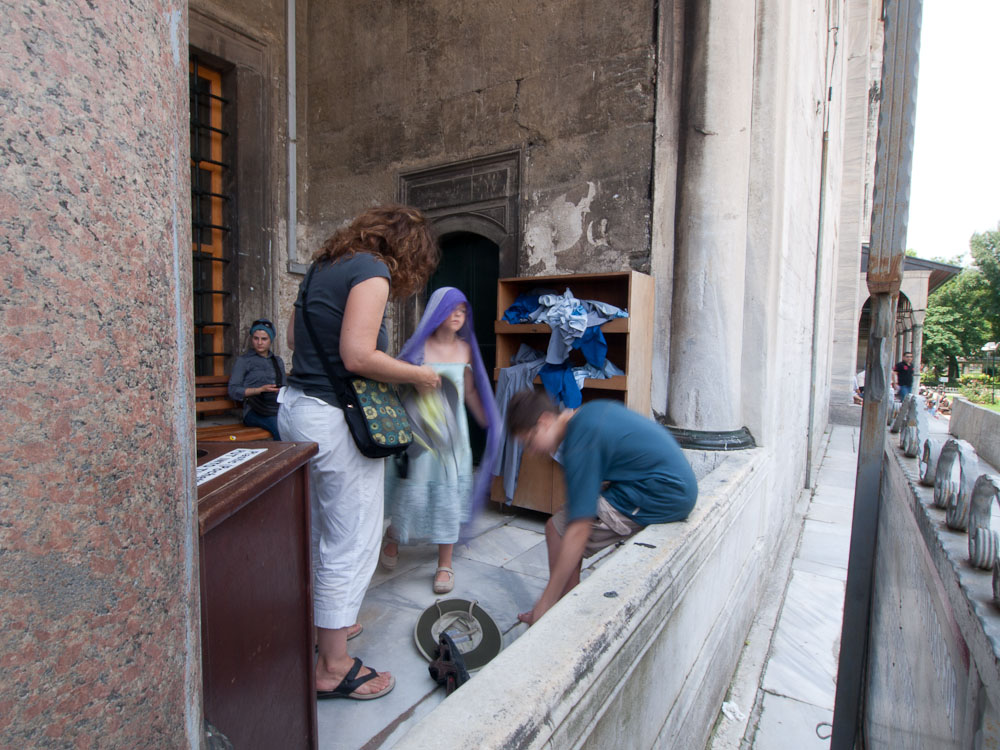
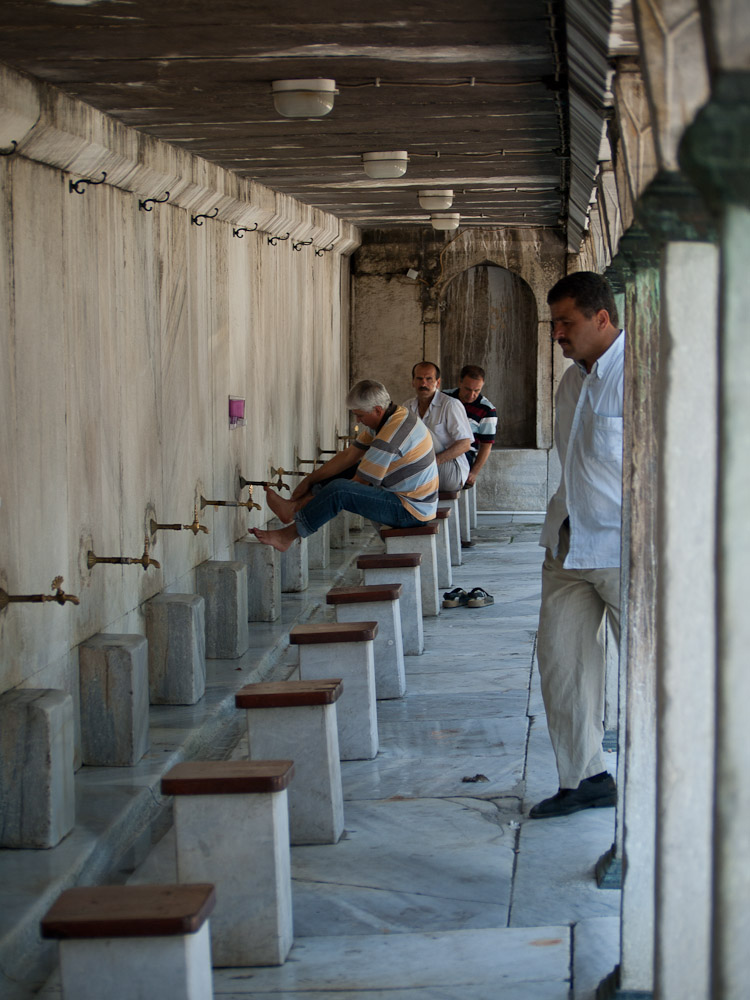
Coming to the mosque, everyone goes to a fountain and washes themselves especially their feet. This is called performing ablutions. (This is an ancient rite and the Romans also did this before entering a temple and even the Greek Oracle did this before entering the Temple of Apollo.) It is done at a running fountain because followers of Islam must avoid stagnant pools of water. The Blue Mosque is so large they have fountains all along the walls:
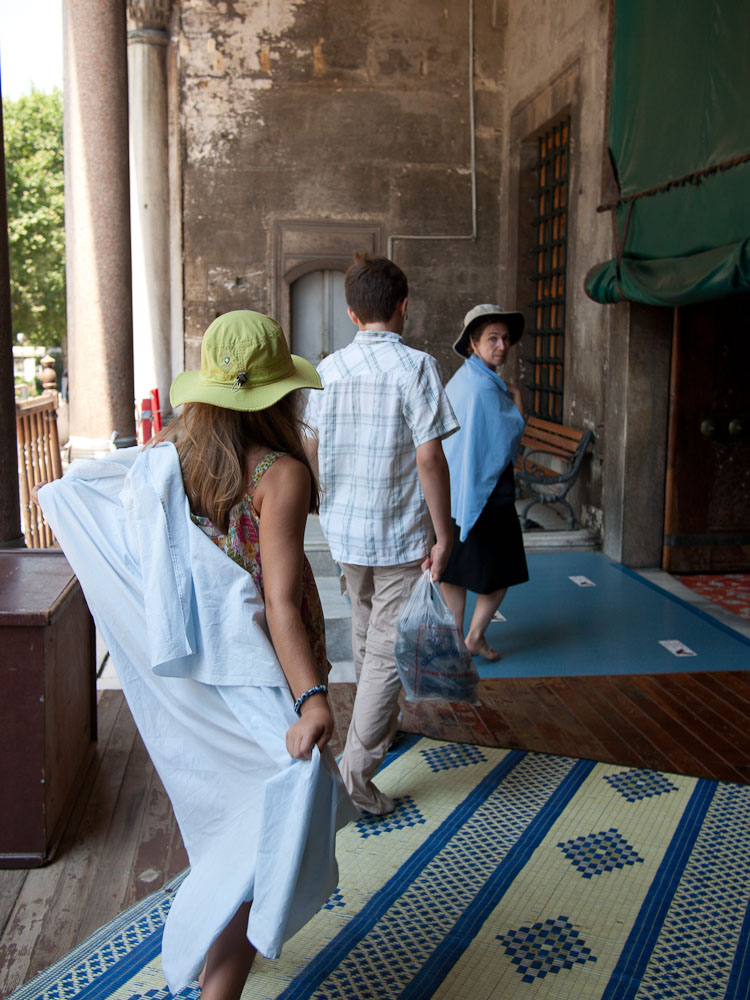
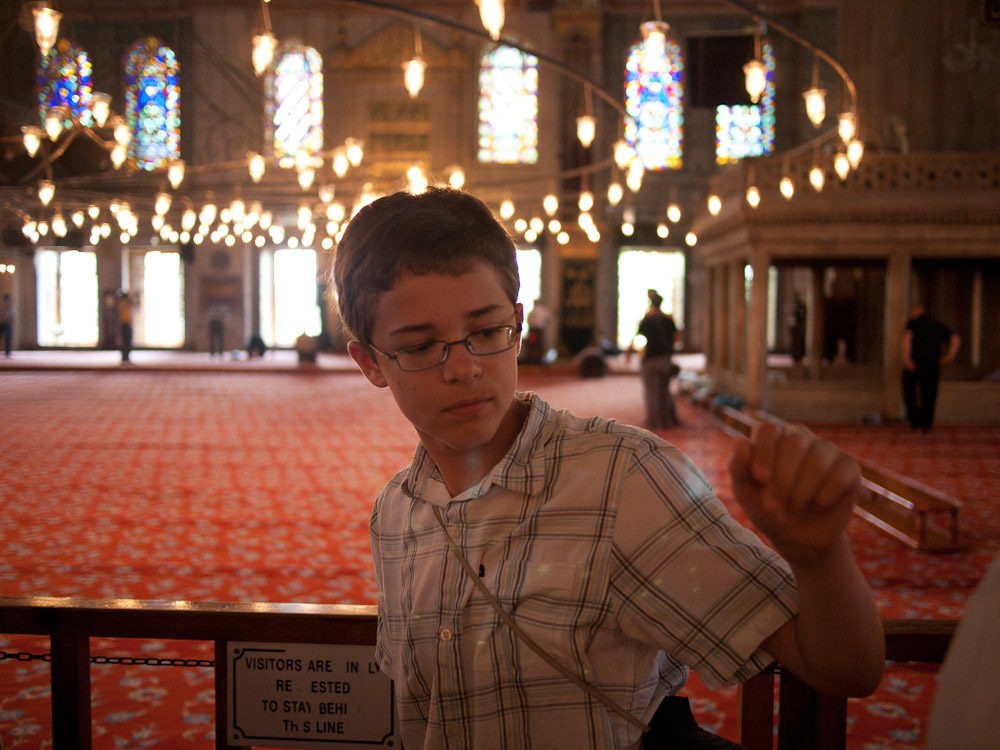
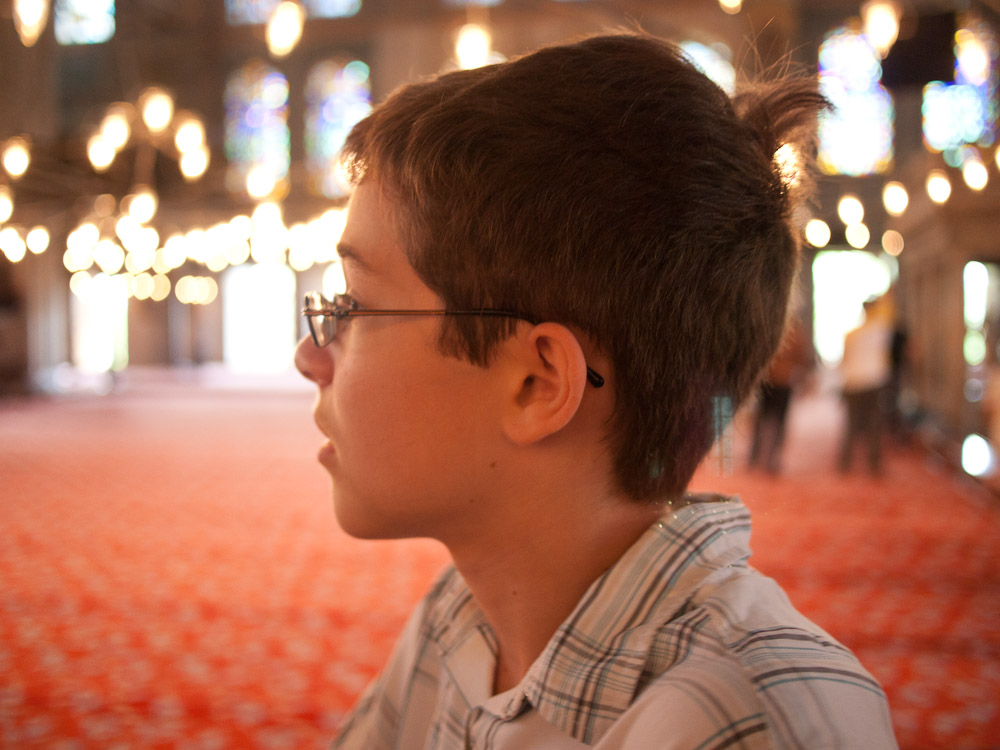
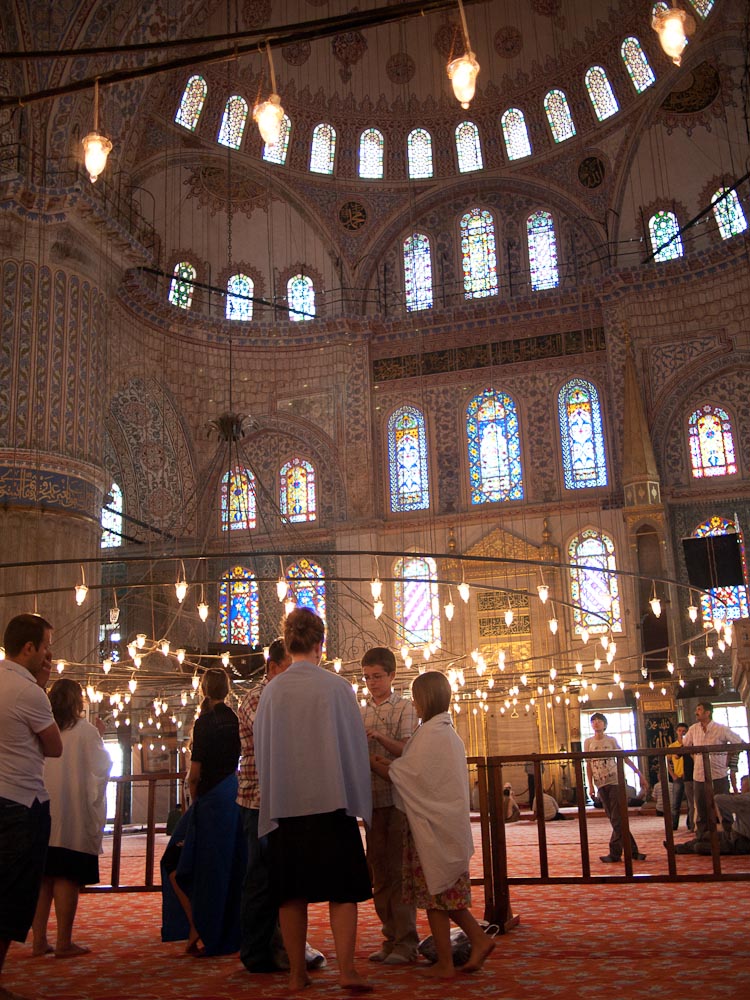
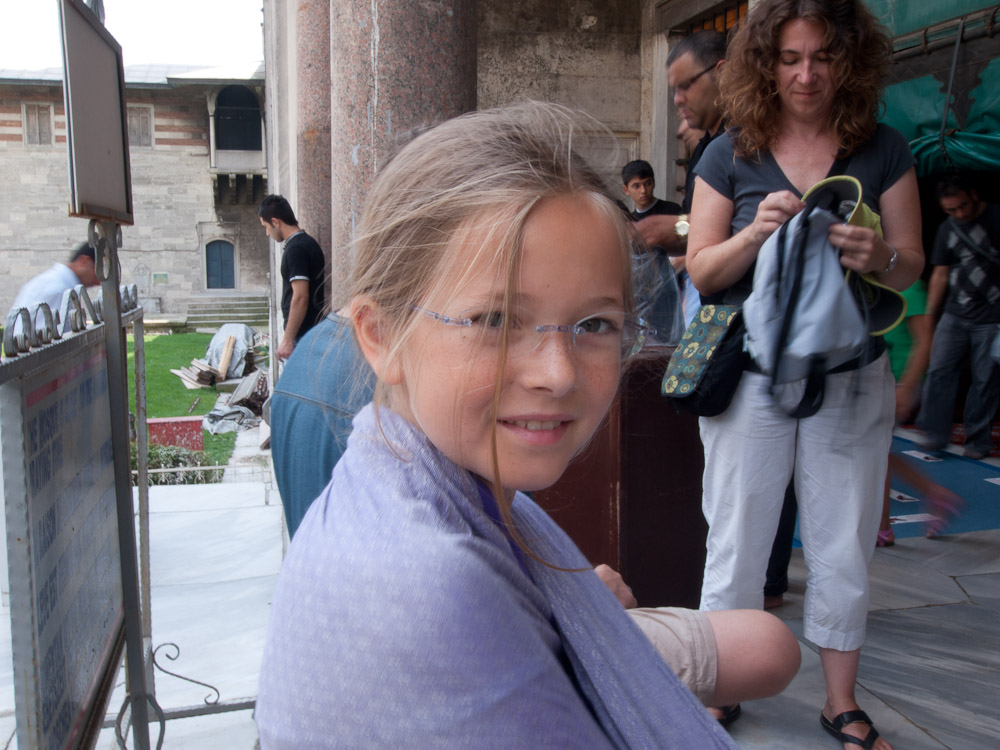
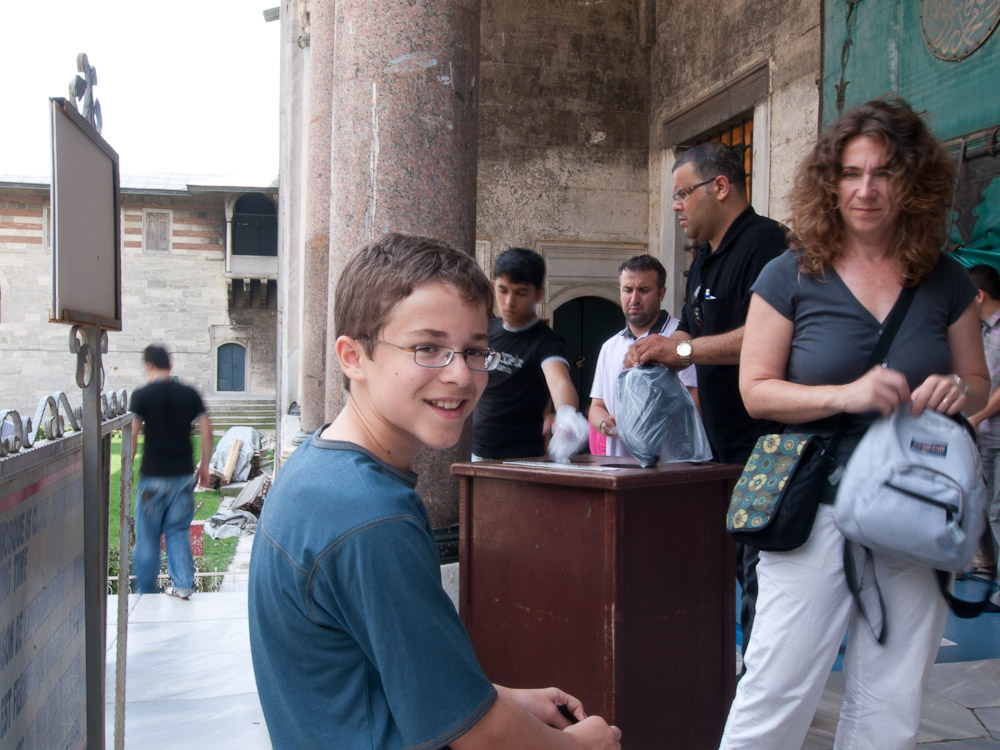
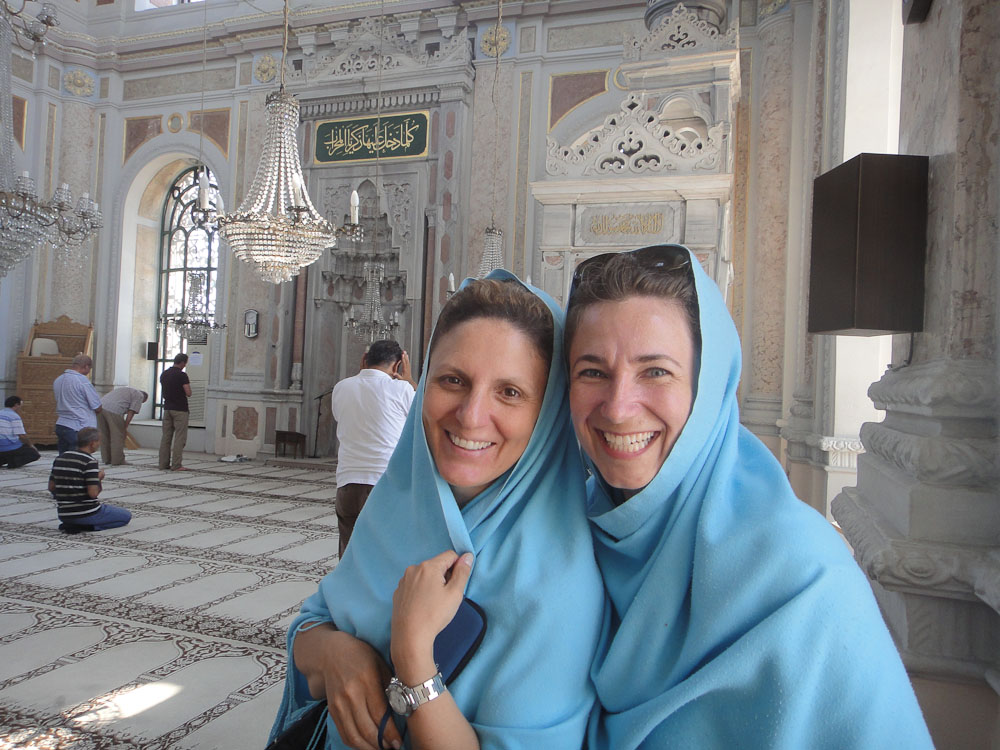
People then file into the Blue Mosque. Cleanliness is vital, so shoes are removed before entering. We carried our shoes in a plastic bag. The mosque is covered in carpets.
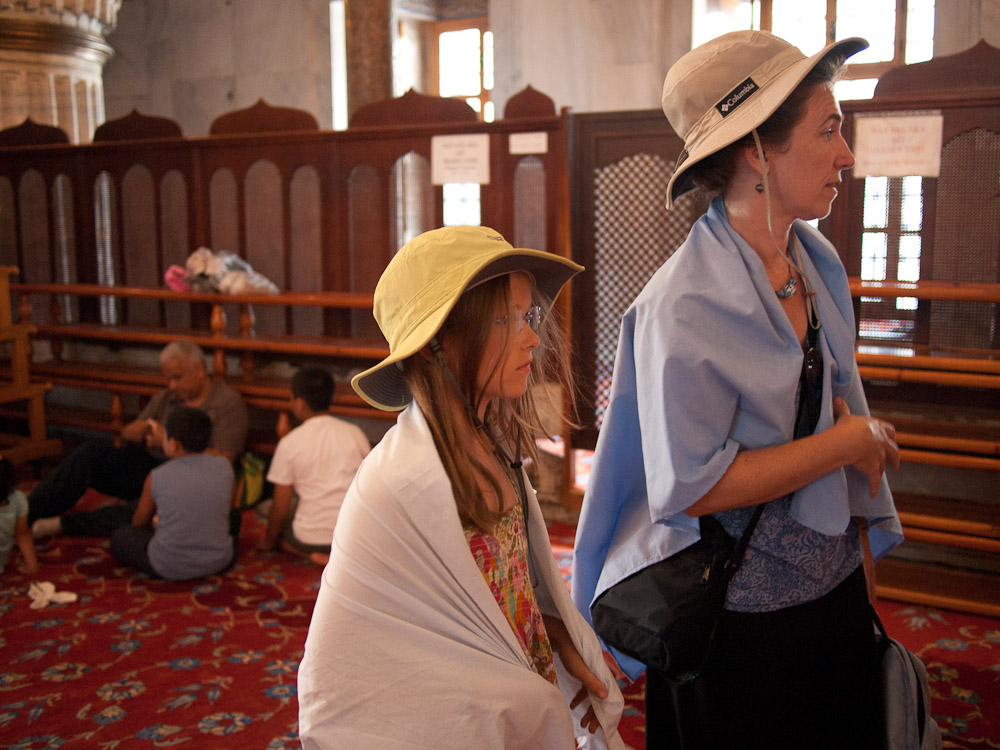
The mosque faces Mecca. An Imam is praying at the front. As services start, the men all move to the front of the room, as close to Mecca as possible. They are arrayed in tight-packed rows from wall to to wall leaving no gaps and pressed to the front of the room. The women move to sections in the back behind wooden screens or in galleries on the second floor; they are also packed in rows as close to Mecca as possible.
Considering that the event is repeated multiple times per day, the service itself is brief. The exception is Fridays, when all men must come to mosque for the mid-day service and the Imam addresses them from the top of a staircase built in the front of the room. (So we have special days for Islam on Friday, Judaism on Saturday, and Christianity on Sunday. Apparently every religion venerates the weekend!)
The praying occurs in silent poses. Everyone begins standing, then a voice calls out a pose and all kneel, a voice calls out a pose and all bend over and place their foreheads on the floor. The cycle of standing, kneeling and bowing are repeated again and again and the order is varied in some logic I could not fathom. Everyone does it silently together. Each time the voice rings out rhythmically and musically. It is quite soothing. The bowing appears to be an expression of the meaning of Islam which is submission to God.
There is no moving around while standing; it is considered a great insult to cross between someone praying and their line to Mecca.
Because everyone is tight packed and bending over, it becomes instantly clear that (1) you really better clean your feet seriously since someone’s forehead will be placed right by them; and (2) separation of the sexes – whether you want to argue it is sexist or not to place women at the back – is really the only practical way to preserve modesty.
After about 20 minutes of these ringing calls to pose, the service ends. Some people file out immediately. Others stay in place and keep rising and bowing while they pray individually.
I had two powerful feelings and insights while watching the ceremony unfold.
The first was awe at how all the people in the mosque – indeed across the city – made the same motions at the same time. It is a powerful sense of unity. When everyone is holding the same pose, we lose the room for doubt or individuality – but we gain a deep sense of harmony with one’s community. On balance it was more reassuring than threatening.
The second realization came from watching hundreds of people all gazing intently (!) at a single point on the earth. Imagine this unfolding across the world – one billion people – all aiming fierce attention and driving their prayers to the same place, five times a day! No wonder a trip to Mecca becomes so important to Muslims. They spend their lives focused on it. Traveling there, they must feel they are basking in that energy.
When the service was over, we quietly walked out and replaced our shoes. We felt privileged to see the ceremony. Later that week we met Gina’s friend at a Mosque and could feel relaxed enough to again stand in the back during the ceremony. It was much the same.
With these experiences, Islam became a bit less of a mystery and a bit more comfortable for us.