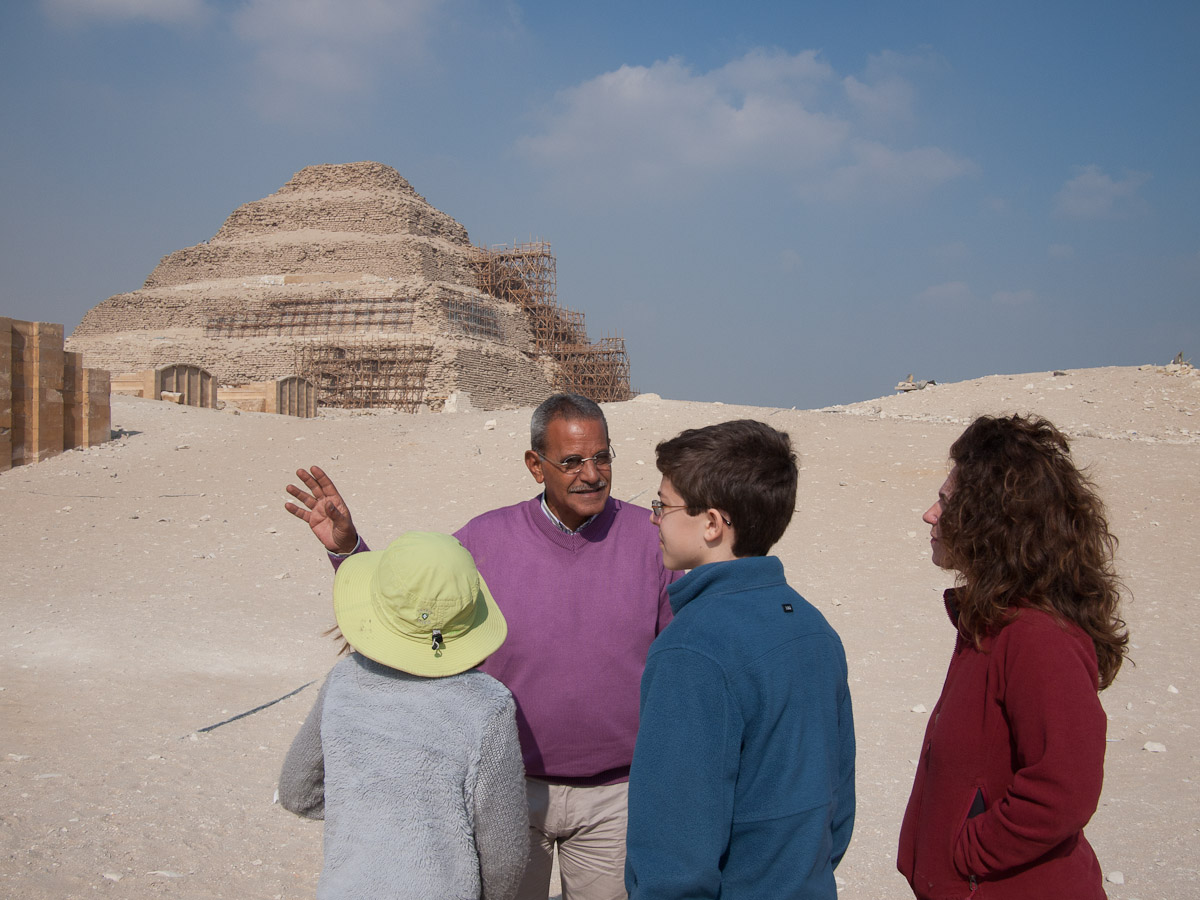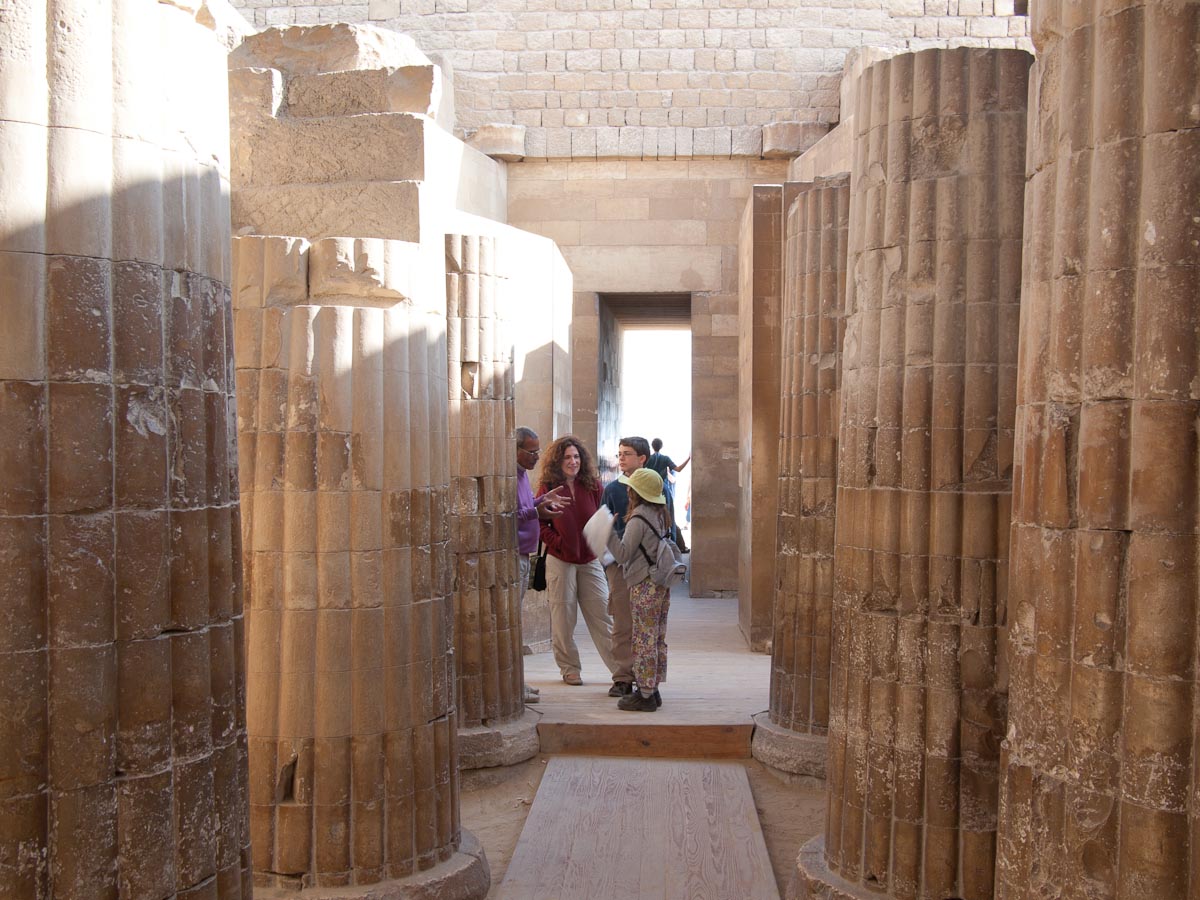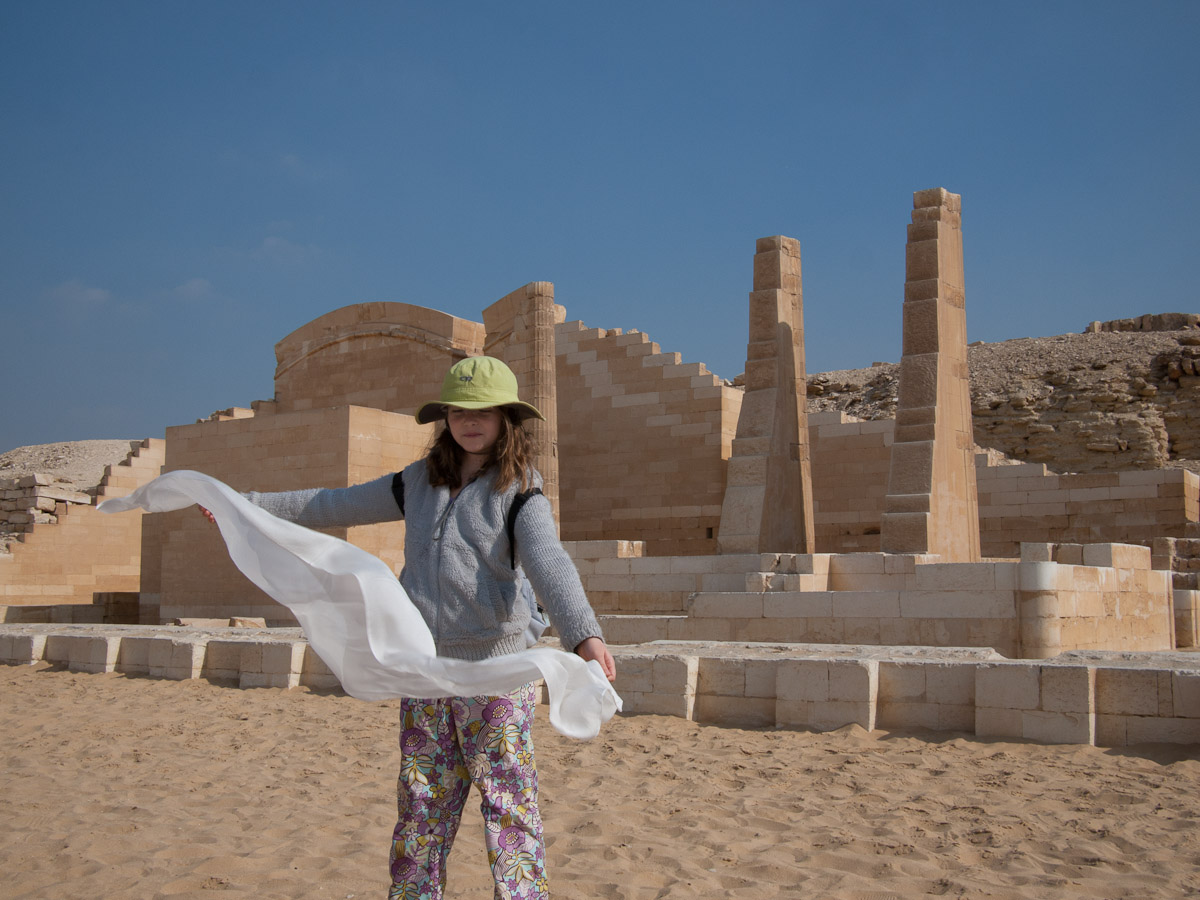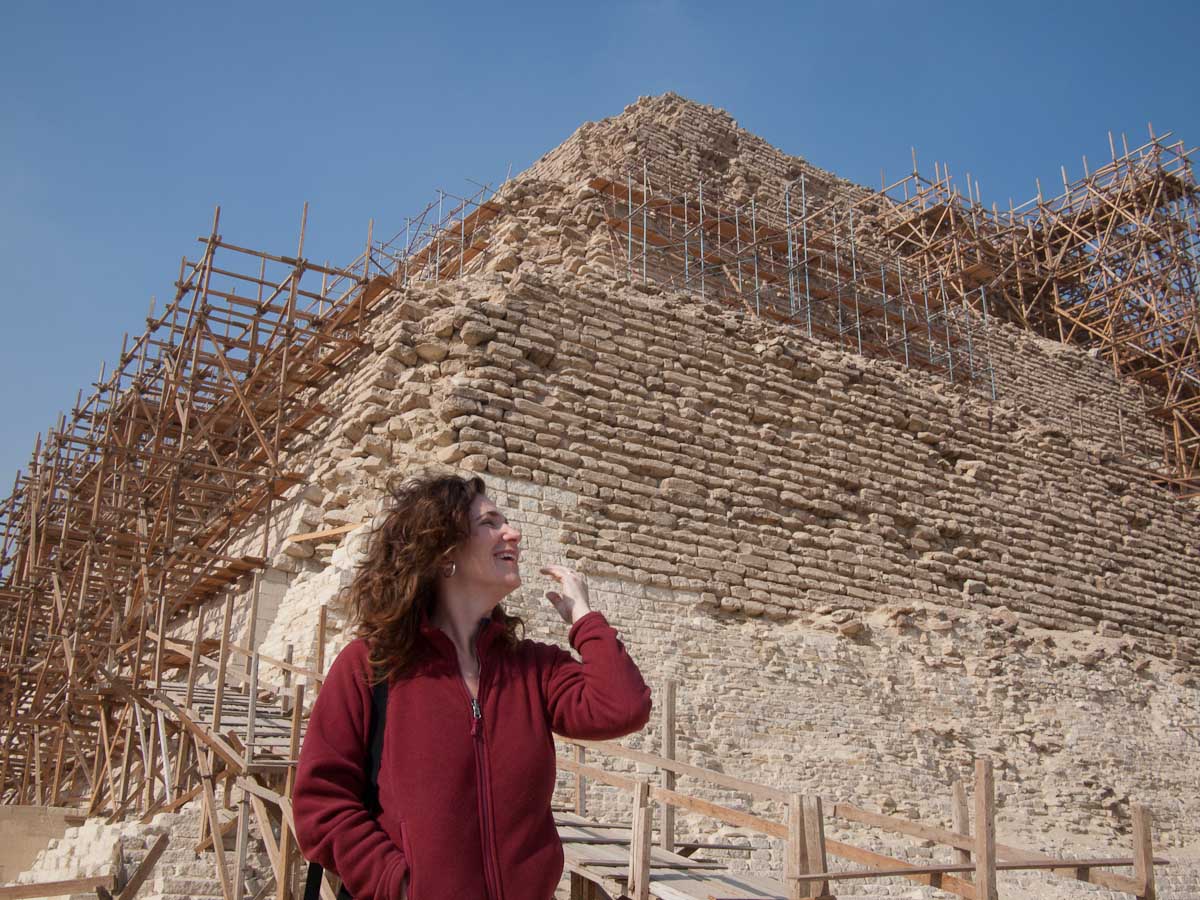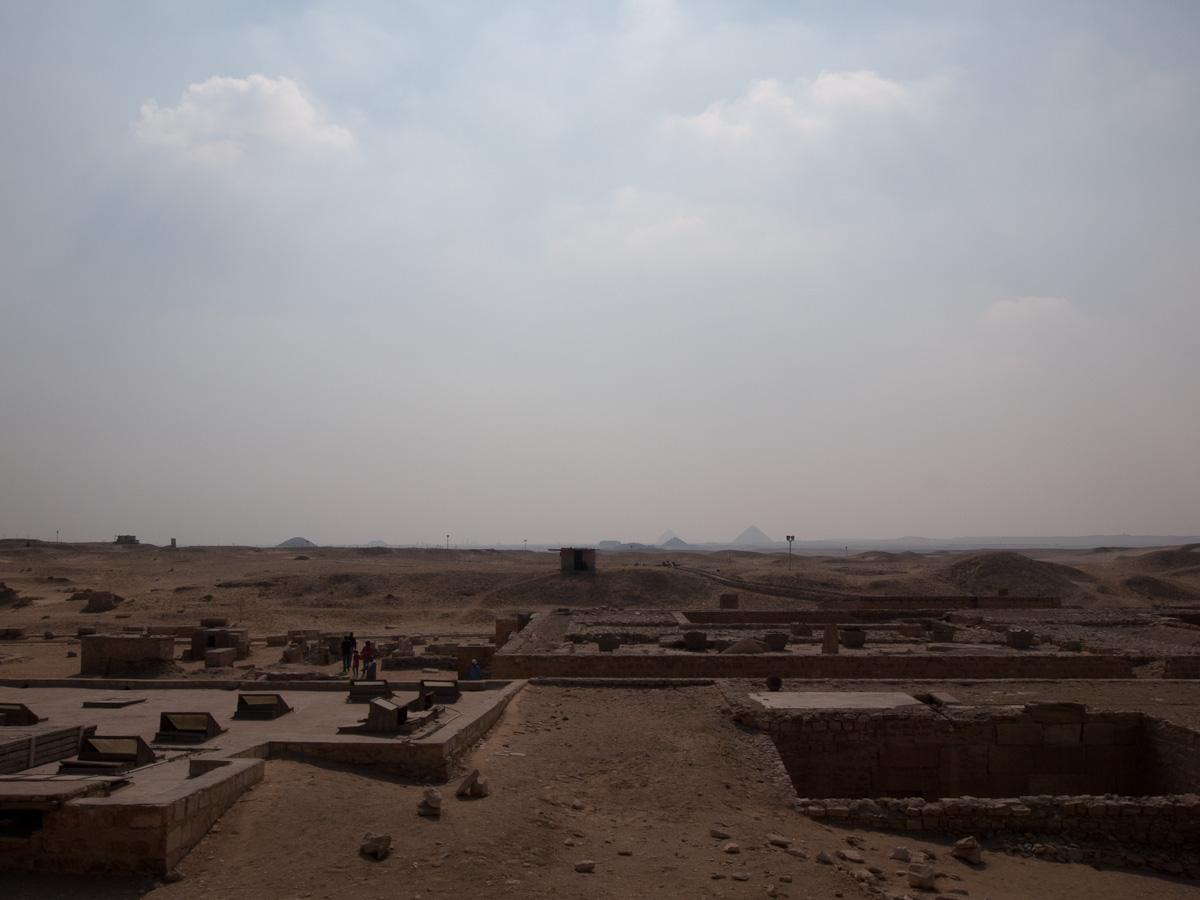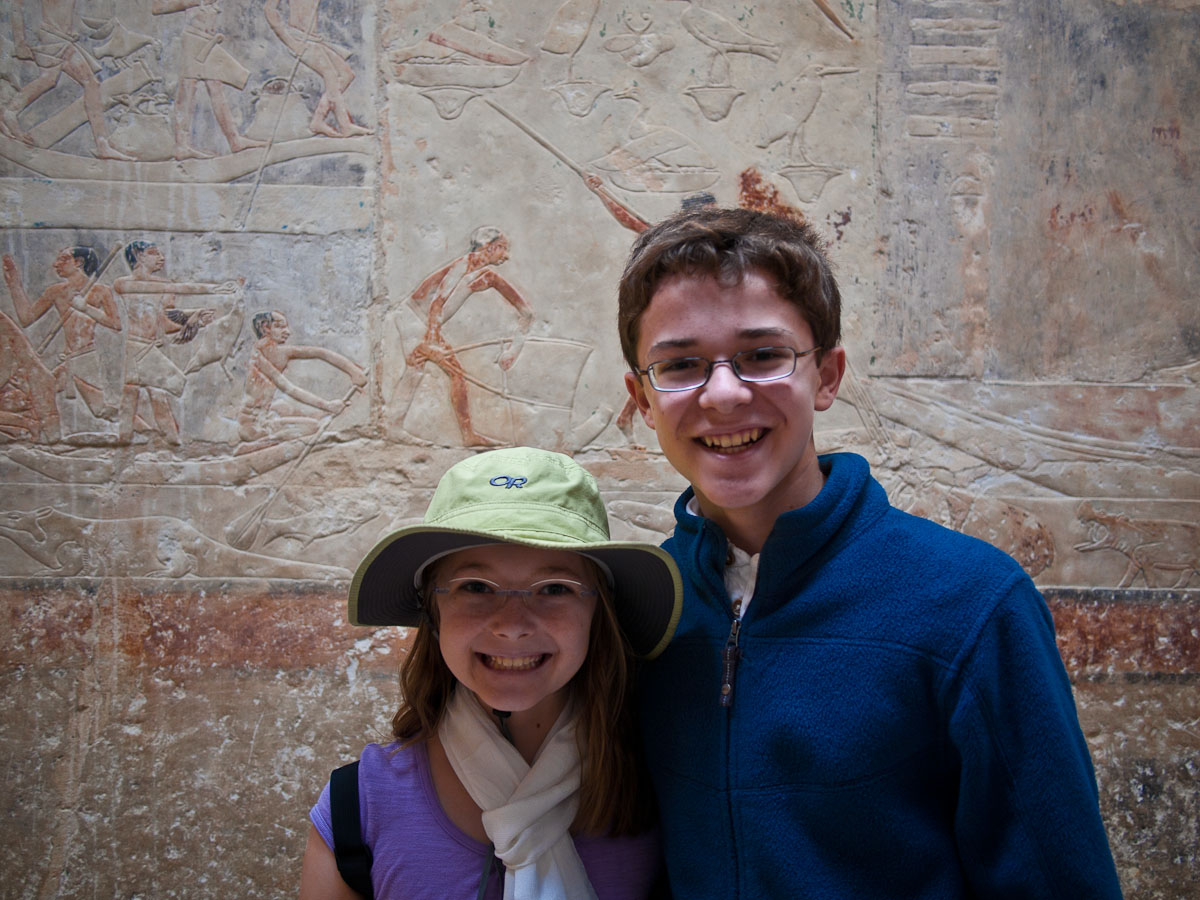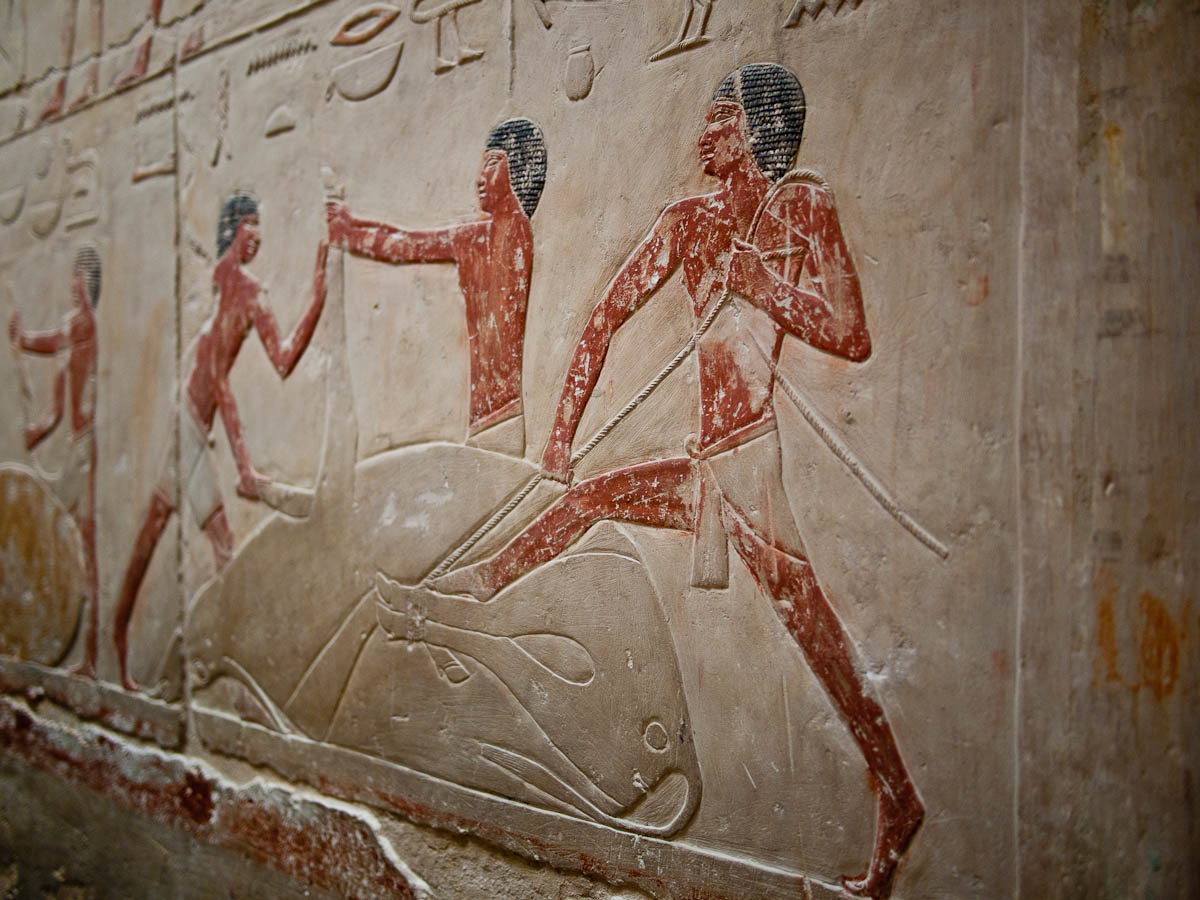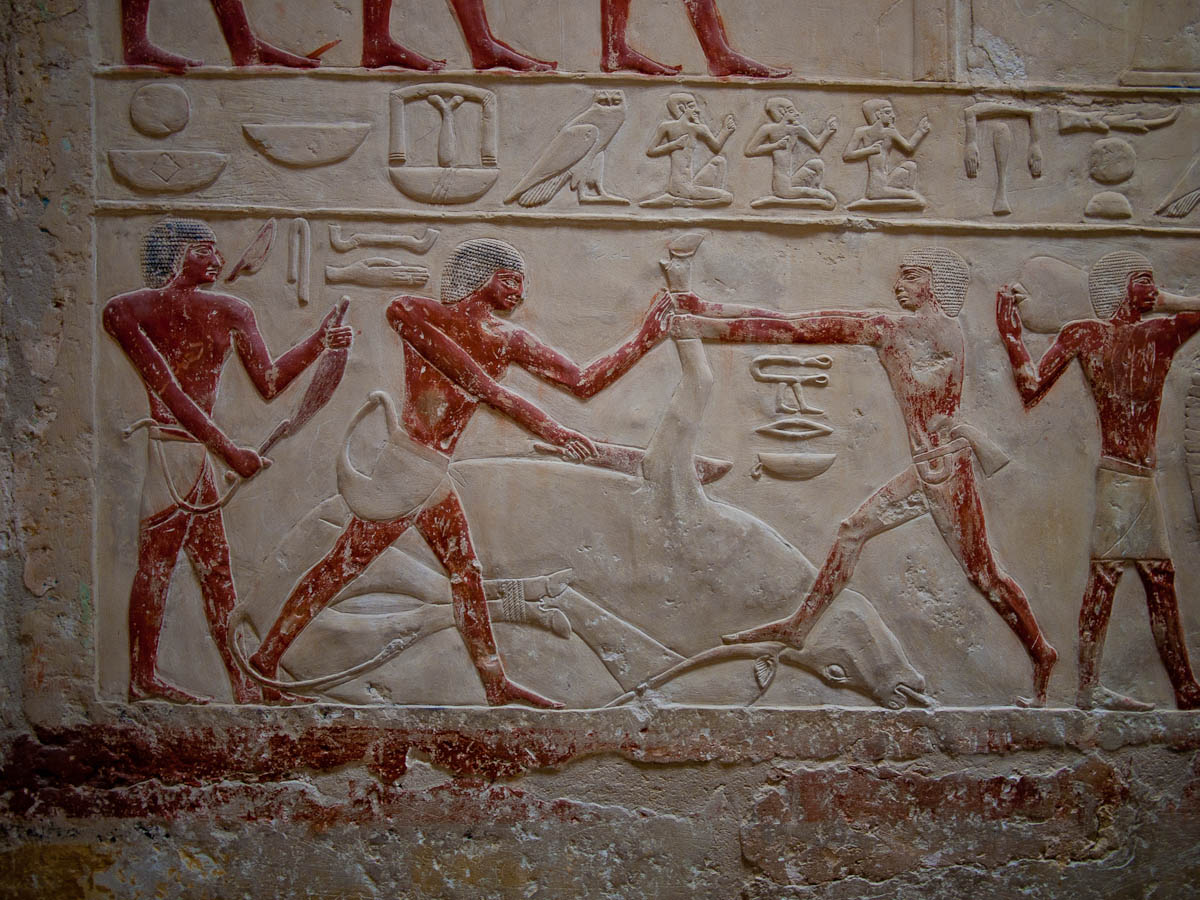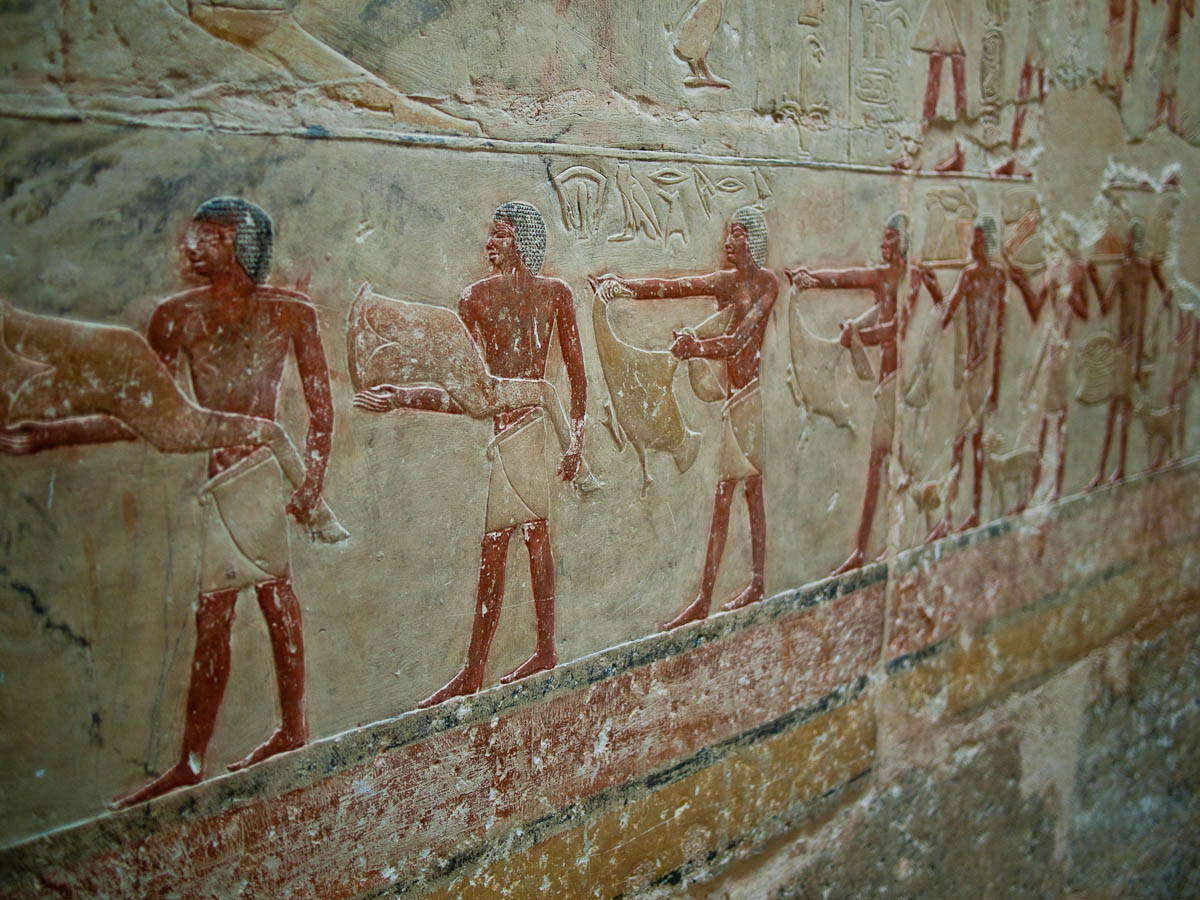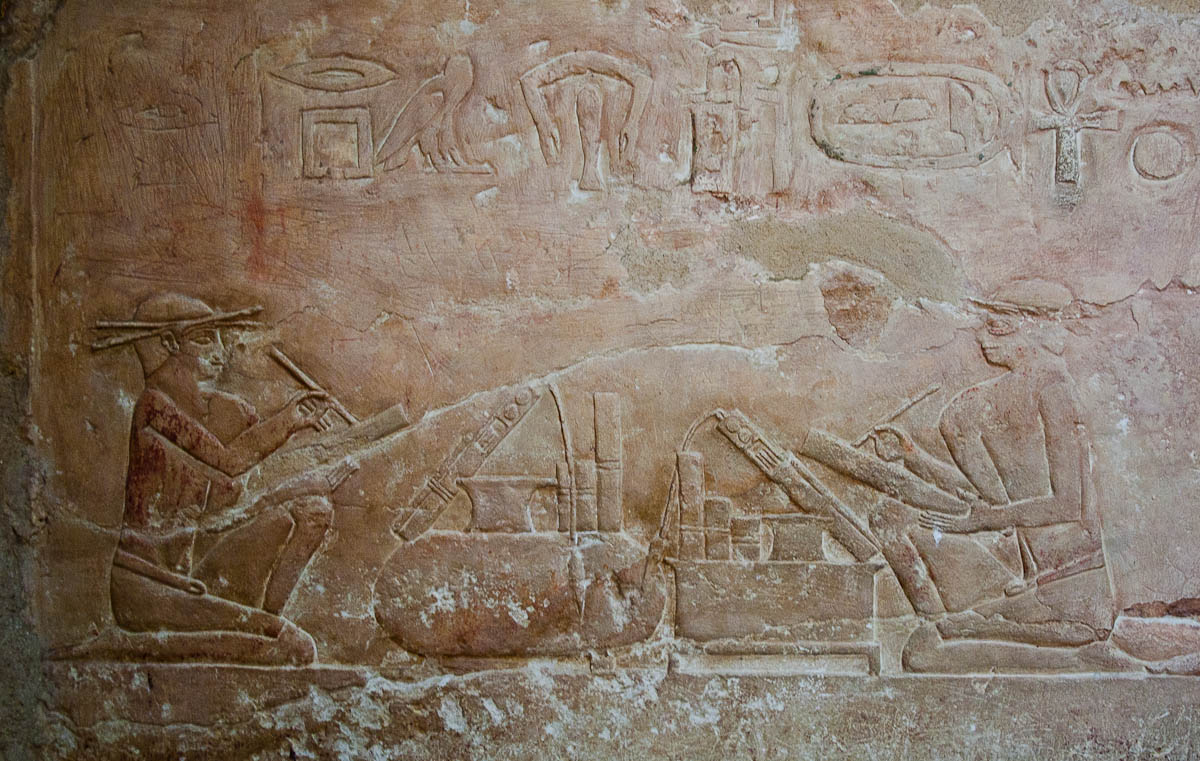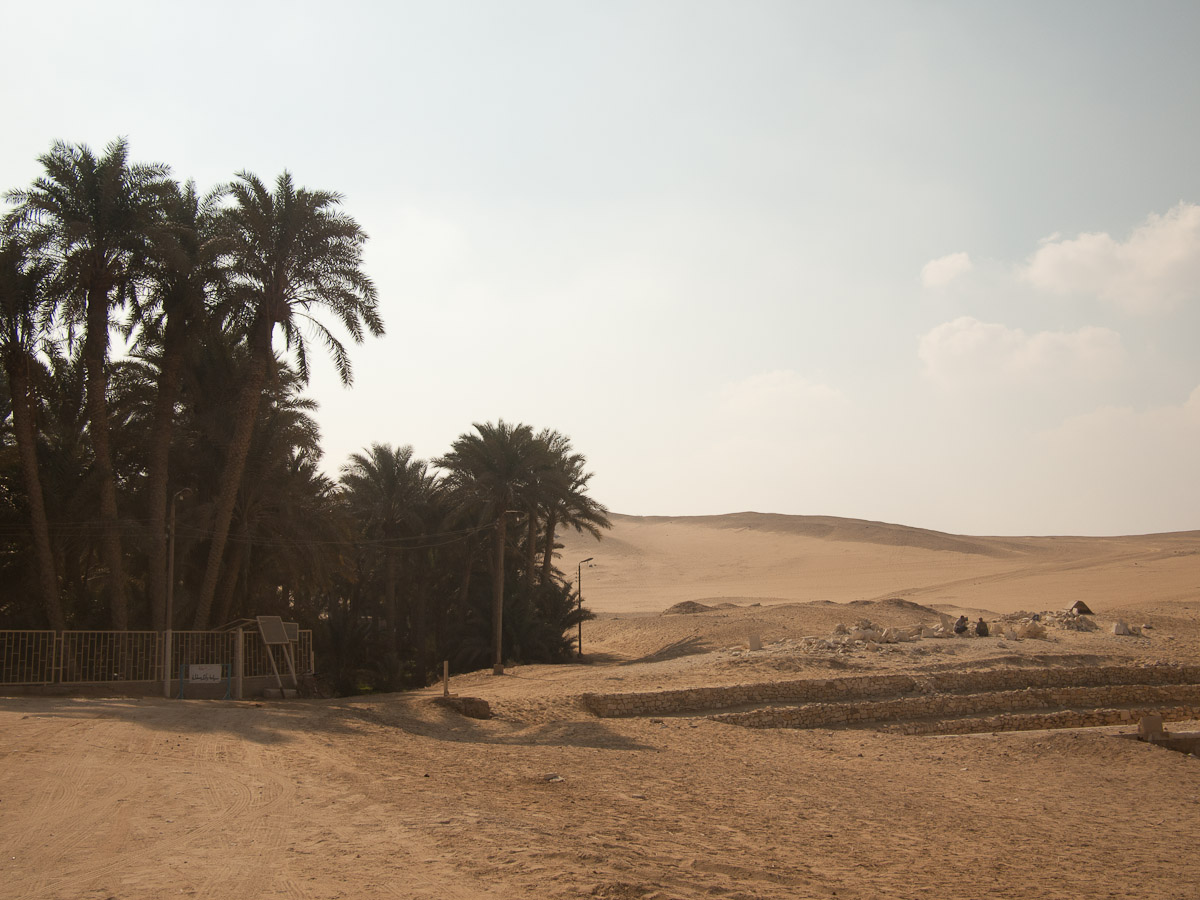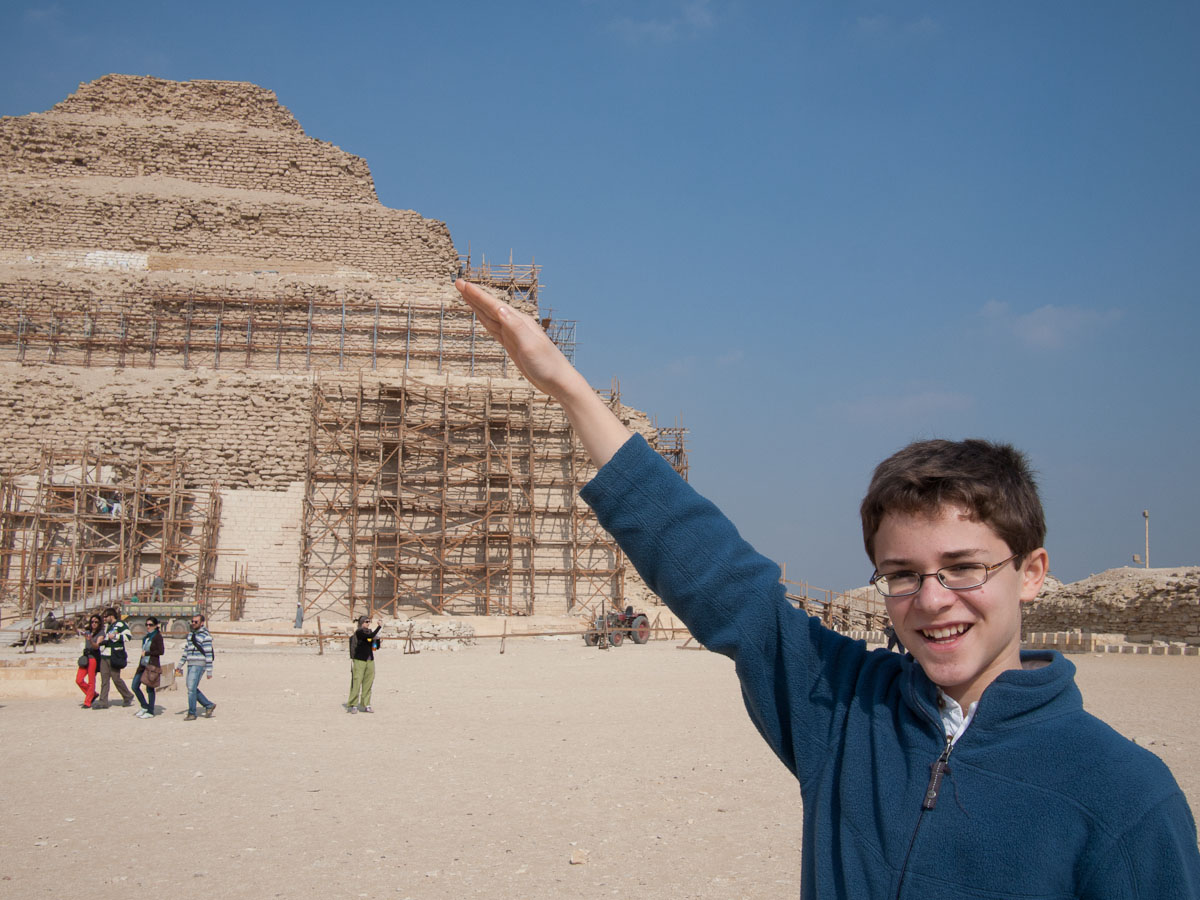
By far the most interesting pyramid to visit is outside Cairo at Saqqara. Here is the oldest of the pyramids, designed by Imhotep. At the time the pharaohs were buried deep in shafts – not 6 feet under but 600 feet under, the depth representing the importance of the pharaoh. This first pyramid was designed as a kind of cap – so big that no one would ever look underneath to loot the grave. The architect Imhotep was the first man in history to use hard stone carved down into polished blocks (rather than built up from mud) as a building material and it worked splendidly to achieve the eternal. Although the workmen did not know how to safely handle the heavy stone, clever Imhotep cured so many broken bones that he was later elevated into the Pantheon of Egyptian gods as the god of medicine. Right by the pyramid is a unique courtyard surrounded by a stone walkway. At that time if the pharaoh achieved a certain age, he was required to run a lap to show he was still fit to rule the upper kingdom of Egypt and then run a second lap to prove he was fit to rule the lower kingdom of Egypt. Amazing to still see the track. Nearby there are also hieroglyphs, the first we had seen with full color paint to embellish the carvings.
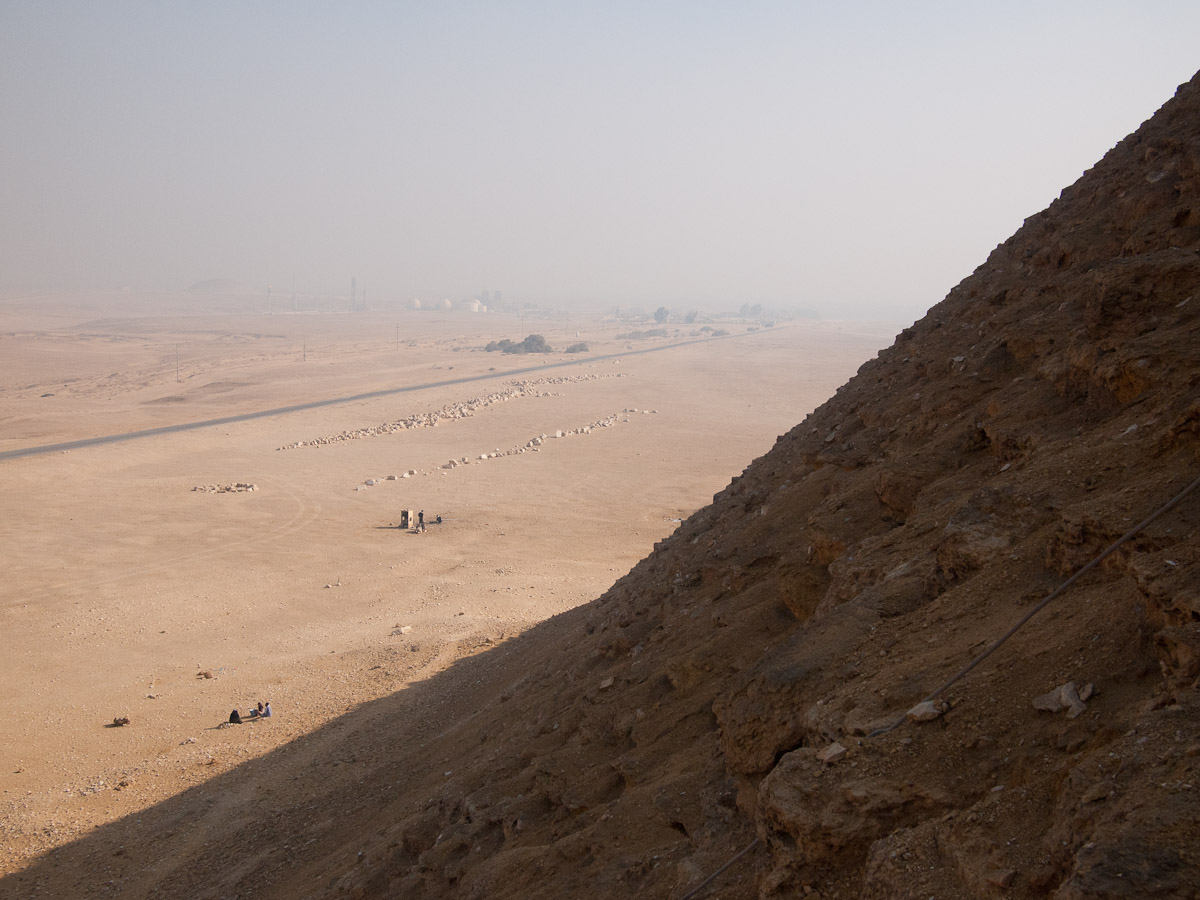
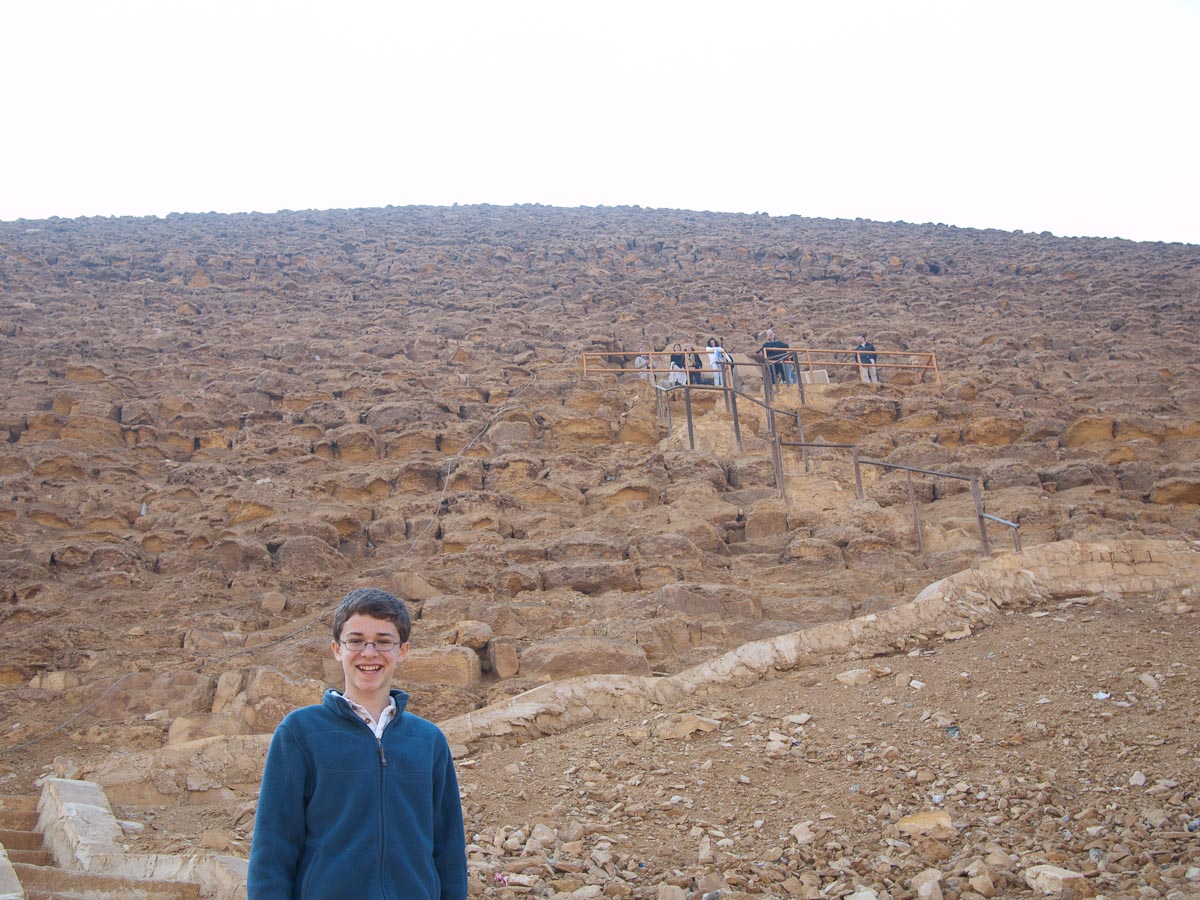
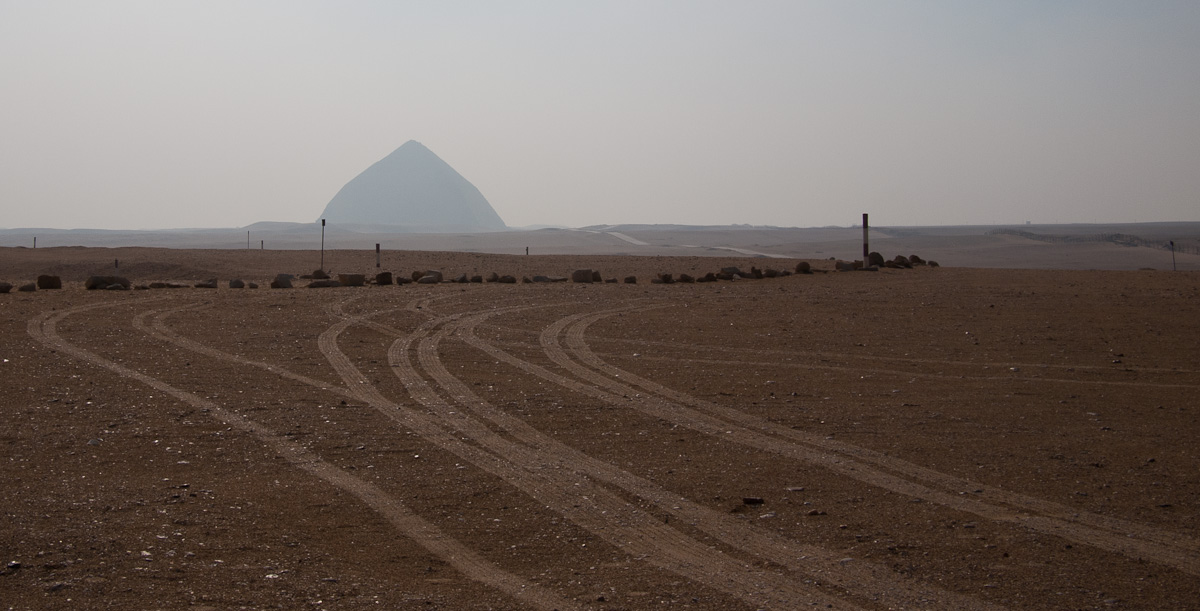
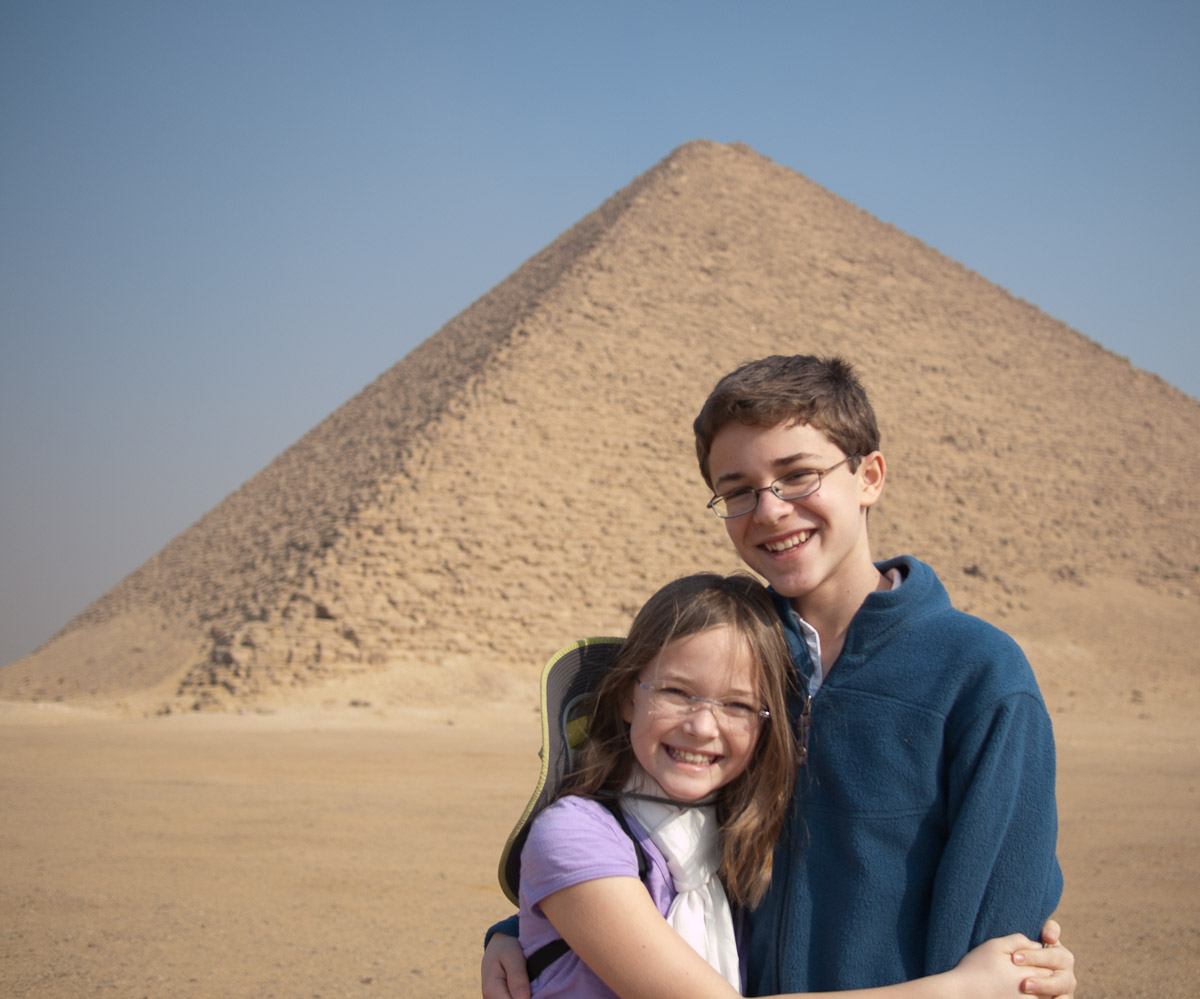
Nearby to Saqqara is Dashar. You can see the predecessors to the pyramid – a step pyramid where the edges are jagged, and a bent pyramid where the engineer chose the wrong angle and had to recalculate halfway through. The pharoah was so incensed that he built a second pyramid, using a new engineer, and the new methods developed for that henceforth allowed the Egyptians to achieve remarkable accuracy.

At Saqqara we learned the ancient story for why the cobra is a sign of protection in Egypt. Long ago there was a god who had one eye. This was so long ago his name has been forgotten. He lived alone for thousands of years. One day he decided he wanted children and so he made a boy and a girl and they lived happily. Eventually however, the children decided they wanted to live by themselves and the god agreed. A few hundred years later he had a sudden feeling that the children might be in trouble. He could not leave though, so he pulled his only eye out of his head and sent it to look for the children. The eye floated around the world and saw the children in trouble and saved them. The god was so happy with the eye that he decided not to put it back in his head. Instead he leaned down and put the eye on the top of the cobra’s head. You can see it there today in red. This is why the cobra is worn as a symbol of protection at the top of the head on Egyptian headdresses. In the Middle East there is a custom that if something is great you pat your head and say “Allah Rassi” which means that was off my head, the equivalent of crazy good or out of this world. Furthermore, when you see someone bowing with a rolling flourish of the fingers from the top of their head, as some actors do, this custom has its origin in the cobra story and the idea of acknowledging something wonderful.
The other must-do activity related to pharaohs in the Cairo area is to visit the Egyptian Museum. This has nine royal mummies and the entire Tutankhamen treasure as Gina described.
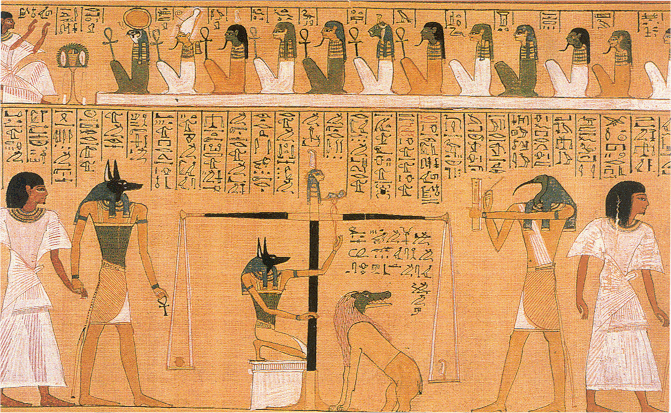
The main story that you may hear the day you visit this museum, right before visiting the leathery mummies with their original hair and remaining teeth, is about the afterlife. I won’t rehash the whole story since it is well published but here a mangled version of the bit that the kids liked the most: upon death, a soul travels to be judged by the gods. The soul has a little book that records all the good and bad things they have done. They explain themselves to a panel of 14 judges. If the judges cannot agree, then the soul is sent to be weighed on one side of a balance scale. On the other side the god places the Feather of Truth. If the soul is heavier than the Feather of Truth, the Devourer eats the heart of the body and it cannot enter the afterlife. If the soul is lighter then it is welcomed.
P.S. Our friend James found a wonderful website for information on Saqqara (in French):
http://jean-marc.mercier.pagesperso-orange.fr/index1.html