
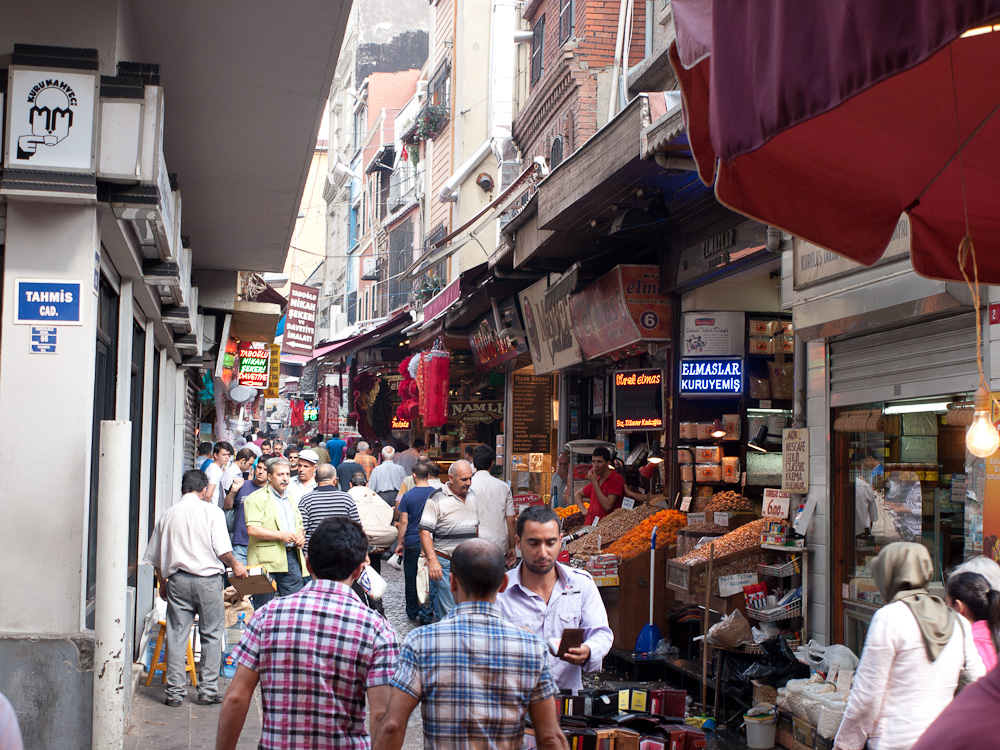
 Istanbul has ancient origins. It became an important city around 500BC when the European side of the Bosphorous was settled by a Greek named Byzos and named Byzantium.
The area has evidence of neothlithic settlements. Far back in history the Black Sea had not connected to the Mediterranean and the Bosphorous Strait must have simply been an arm of water. Our guide favors a theory that an earthquake created the connection suddenly and caused the Black Sea (with a higher elevation that the Mediterranean) to suddenly flood the area. This could have been the origin behind Noah’s Flood; some say remains of Noah’s Ark has been found on a Turkish mountain. We also know that Christians were living in middle Turkey as early as 3rd and 4th century AD, hiding from Roman persecution in the Cappadocia area. This is the time of the Cappadocia churches and underground dwellings.
The city and all of Turkey were dominated by Greeks and Alexander the Great; then later absorbed by the Roman Empire. The city had an enormous Hippodrome for chariot races that was built by the Romans to appease te newly conquered citizens. Emperor Constantine moved the capital of the Roman Empire to Byzantium city, calling it Nova Roma, and it became known as Constantinople. This is the time of the Hagia Sofia. The Empire split into East and West, and the East side became known as the Byzantine Empire (even though the city itself had now become known as Constantinople). The Byzantine Empire while ruled under Roman law was notably Greek-speaking and Greek Orthodox. Over the centuries it lost territories to successive invaders, including local Turks, however it was still extraordinarily successful lasting roughly 1000 years.
Located at the crossroads of Asia and Europe and near to Africa, Constantinople was a center of commerce and wealth and was able to remain an independent city for another millenium. There was a sorry episode in the 1200s where the Crusaders were offered shelter in Constantinople on their way to Jerusalem, but the Crusaders betrayed their hosts and sacked the city. Venetians also took control for a period by agreement rather than force. Militarily, the city withstood a dozen sieges successfully, owing to its strong walls and ocean defenses.
Meanwhile the Turks, themselves a mix of many groups that swept in from Central Asia, split into various kingdoms and many of those were Islamic. Of these, Ottomans grew powerful and finally in 1453AD, they managed to storm and win Constantinople – the 13th siege being the unlucky one for the city.
Part of the exoticness of Turkey comes from the Central Asian roots of its people. The word stems are simply unlike anything you might find familiar from Romance languages and are more closely related to Mongolian and Korean. Turkish is spoken deep in the throat and there is a fair amount of word sharing with Persian and to a lesser extent Arabic languages. Old Turkish was written in the Orkhan script and as in Asian cultures, calligraphy was venerated.
The conquering Ottoman Empire promptly made Constantinople their capital city and converted the churches to mosques, thankfully preserving a great deal of the Church artwork under coverings. The Empire continued to expand. This is the time of the Blue Mosque and the Topkapi Palace, as well as the historic Turkish Bath we visited.
By the mid-1600s under Suleyman, the Ottoman Empire had grown to control all of Turkey, Iraq, most Iran, Egypt, Hungary and 75% of the lands surrounding the Mediterranean.
The Ottoman Empire functioned by laws that allowed territories a fair degree of autonomy, similar to the Romans. The two pillars of its strength were strong central authority of the Sultanate and the Janissaries. The Janissaries recruited foreign and Christian boys age 15-17, brought them back to Turkey, converted them to Islam, and trained them as highly skilled fighters. The smartest of the Janissaries were brought to Istanbul, where they were further educated, and the best of these became leaders in the Ottoman government and in some cases were married to the Sultan’s daughters to keep them close to the ruling family.
The Sultan was extremely powerful and maintained a harem which included multiple wives and favorites. While originally, the Sultanate was passed down to the first born male, they later decided to pass the Sultanate to the son with the highest merit, which perversely touched off enormous scheming and tight control over chances for the Sultanate to produce heirs. Visiting the Topkapi Palace, we learned the Sultan entered the harem only after passing through... his mother's apartments! The mother and wives played a key role in selecting the Sultan's favorites because the stakes were high. This infighting weakened clarity of control over the next 150 years; at times the Janissaries stepped in and actually removed certain Sultans. This is in fact a practice that has stuck with Turkey, as its military has stepped in several times to change its democractic leadership; far from being scary to the Turks this is natural.
One of the small facts we learned is that the trading Turks have a long history of friendship with the Dutch, and that the tulip came to the Dutch via Turkey. Indeed the Sultan's throne room is decorated not in Turkish tiles - which are exquisite - but in Delft! The tulip gift, whose named sounds like Allah in Turkish and is therefore a symbol of Turkey, touched off the Tulip Mania. Our guide claims the Americans benefitted as well, bring a meaty game bird from Turkey to America where it became known as our beloved Turkey.
The Ottoman Empire wound down and became bankrupt around World War I. Fighting on the losing side, the country appeared ready for carving up after the War. However the commander who had led the Turks valiantly at Gallipoli, Mustafa Kemal Ataturk, rallied the country and fended off an invasion by the Greeks. He then made sweeping changes to the country, adopting a secular government, ending the Sultanate formally, and forcing many Westernizations. He remains Turkey’s greatest modern hero. He died November 10, 1938 at 9:05am of illness, and every non-functional clock in every Turkish museum is set to that time.
Today, Turkey is a rare animal: a secular Westernized state with a 99% Muslim population. This is a place where you can drink a glass of wine while listening to the Muslim call to prayer five times a day. The disconnect can be resolved somewhat when you consider (1) the deep cosmopolitan history of Turkey as a bridge country among Europe, Asia and Africa; (2) a Mediterranean flavor and arid climate in line with Spain, Italy and Greece; (3) Turkey lost greatly by falling behind the West in the past century - forced to focus on agriculture by Great Powers and now trying desperately to catch up industrially - and does not want to be so isolated again.
The Turks consider themselves descended from warriors, originated military band music, love wrestling, and have all served in the military as service is compulsory for 15 months (12 for college grads). The main industries are textiles, tourism and agriculture. About 70% of the population lives in cities leaving 30% still in the countryside. The issues of the day are the role of an activist army and an activist supreme court, which both tend to weaken the strength of the democratically elected Parliament. A plebiscite is coming up in September that would impose some limits on the military, so this is something to watch closely. This is the modern time of the Takshim shopping district and waterfront cafes we visited.
Istanbul has ancient origins. It became an important city around 500BC when the European side of the Bosphorous was settled by a Greek named Byzos and named Byzantium.
The area has evidence of neothlithic settlements. Far back in history the Black Sea had not connected to the Mediterranean and the Bosphorous Strait must have simply been an arm of water. Our guide favors a theory that an earthquake created the connection suddenly and caused the Black Sea (with a higher elevation that the Mediterranean) to suddenly flood the area. This could have been the origin behind Noah’s Flood; some say remains of Noah’s Ark has been found on a Turkish mountain. We also know that Christians were living in middle Turkey as early as 3rd and 4th century AD, hiding from Roman persecution in the Cappadocia area. This is the time of the Cappadocia churches and underground dwellings.
The city and all of Turkey were dominated by Greeks and Alexander the Great; then later absorbed by the Roman Empire. The city had an enormous Hippodrome for chariot races that was built by the Romans to appease te newly conquered citizens. Emperor Constantine moved the capital of the Roman Empire to Byzantium city, calling it Nova Roma, and it became known as Constantinople. This is the time of the Hagia Sofia. The Empire split into East and West, and the East side became known as the Byzantine Empire (even though the city itself had now become known as Constantinople). The Byzantine Empire while ruled under Roman law was notably Greek-speaking and Greek Orthodox. Over the centuries it lost territories to successive invaders, including local Turks, however it was still extraordinarily successful lasting roughly 1000 years.
Located at the crossroads of Asia and Europe and near to Africa, Constantinople was a center of commerce and wealth and was able to remain an independent city for another millenium. There was a sorry episode in the 1200s where the Crusaders were offered shelter in Constantinople on their way to Jerusalem, but the Crusaders betrayed their hosts and sacked the city. Venetians also took control for a period by agreement rather than force. Militarily, the city withstood a dozen sieges successfully, owing to its strong walls and ocean defenses.
Meanwhile the Turks, themselves a mix of many groups that swept in from Central Asia, split into various kingdoms and many of those were Islamic. Of these, Ottomans grew powerful and finally in 1453AD, they managed to storm and win Constantinople – the 13th siege being the unlucky one for the city.
Part of the exoticness of Turkey comes from the Central Asian roots of its people. The word stems are simply unlike anything you might find familiar from Romance languages and are more closely related to Mongolian and Korean. Turkish is spoken deep in the throat and there is a fair amount of word sharing with Persian and to a lesser extent Arabic languages. Old Turkish was written in the Orkhan script and as in Asian cultures, calligraphy was venerated.
The conquering Ottoman Empire promptly made Constantinople their capital city and converted the churches to mosques, thankfully preserving a great deal of the Church artwork under coverings. The Empire continued to expand. This is the time of the Blue Mosque and the Topkapi Palace, as well as the historic Turkish Bath we visited.
By the mid-1600s under Suleyman, the Ottoman Empire had grown to control all of Turkey, Iraq, most Iran, Egypt, Hungary and 75% of the lands surrounding the Mediterranean.
The Ottoman Empire functioned by laws that allowed territories a fair degree of autonomy, similar to the Romans. The two pillars of its strength were strong central authority of the Sultanate and the Janissaries. The Janissaries recruited foreign and Christian boys age 15-17, brought them back to Turkey, converted them to Islam, and trained them as highly skilled fighters. The smartest of the Janissaries were brought to Istanbul, where they were further educated, and the best of these became leaders in the Ottoman government and in some cases were married to the Sultan’s daughters to keep them close to the ruling family.
The Sultan was extremely powerful and maintained a harem which included multiple wives and favorites. While originally, the Sultanate was passed down to the first born male, they later decided to pass the Sultanate to the son with the highest merit, which perversely touched off enormous scheming and tight control over chances for the Sultanate to produce heirs. Visiting the Topkapi Palace, we learned the Sultan entered the harem only after passing through... his mother's apartments! The mother and wives played a key role in selecting the Sultan's favorites because the stakes were high. This infighting weakened clarity of control over the next 150 years; at times the Janissaries stepped in and actually removed certain Sultans. This is in fact a practice that has stuck with Turkey, as its military has stepped in several times to change its democractic leadership; far from being scary to the Turks this is natural.
One of the small facts we learned is that the trading Turks have a long history of friendship with the Dutch, and that the tulip came to the Dutch via Turkey. Indeed the Sultan's throne room is decorated not in Turkish tiles - which are exquisite - but in Delft! The tulip gift, whose named sounds like Allah in Turkish and is therefore a symbol of Turkey, touched off the Tulip Mania. Our guide claims the Americans benefitted as well, bring a meaty game bird from Turkey to America where it became known as our beloved Turkey.
The Ottoman Empire wound down and became bankrupt around World War I. Fighting on the losing side, the country appeared ready for carving up after the War. However the commander who had led the Turks valiantly at Gallipoli, Mustafa Kemal Ataturk, rallied the country and fended off an invasion by the Greeks. He then made sweeping changes to the country, adopting a secular government, ending the Sultanate formally, and forcing many Westernizations. He remains Turkey’s greatest modern hero. He died November 10, 1938 at 9:05am of illness, and every non-functional clock in every Turkish museum is set to that time.
Today, Turkey is a rare animal: a secular Westernized state with a 99% Muslim population. This is a place where you can drink a glass of wine while listening to the Muslim call to prayer five times a day. The disconnect can be resolved somewhat when you consider (1) the deep cosmopolitan history of Turkey as a bridge country among Europe, Asia and Africa; (2) a Mediterranean flavor and arid climate in line with Spain, Italy and Greece; (3) Turkey lost greatly by falling behind the West in the past century - forced to focus on agriculture by Great Powers and now trying desperately to catch up industrially - and does not want to be so isolated again.
The Turks consider themselves descended from warriors, originated military band music, love wrestling, and have all served in the military as service is compulsory for 15 months (12 for college grads). The main industries are textiles, tourism and agriculture. About 70% of the population lives in cities leaving 30% still in the countryside. The issues of the day are the role of an activist army and an activist supreme court, which both tend to weaken the strength of the democratically elected Parliament. A plebiscite is coming up in September that would impose some limits on the military, so this is something to watch closely. This is the modern time of the Takshim shopping district and waterfront cafes we visited.
Background on Byzantium, Ottoman Empire, and Turkey
Istanbul has ancient origins. It became an important city around 500BC when the European side of the Bosphorous was settled by a Greek named Byzos and named Byzantium.
The area has evidence of neothlithic settlements. Far back in history the Black Sea had not connected to the Mediterranean and the Bosphorous Strait must have simply been an arm of water. Our guide favors a theory that an earthquake created the connection suddenly and caused the Black Sea (with a higher elevation that the Mediterranean) to suddenly flood the area. This could have been the origin behind Noah’s Flood; some say remains of Noah’s Ark has been found on a Turkish mountain. We also know that Christians were living in middle Turkey as early as 3rd and 4th century AD, hiding from Roman persecution in the Cappadocia area. This is the time of the Cappadocia churches and underground dwellings.
The city and all of Turkey were dominated by Greeks and Alexander the Great; then later absorbed by the Roman Empire. The city had an enormous Hippodrome for chariot races that was built by the Romans to appease te newly conquered citizens. Emperor Constantine moved the capital of the Roman Empire to Byzantium city, calling it Nova Roma, and it became known as Constantinople. This is the time of the Hagia Sofia. The Empire split into East and West, and the East side became known as the Byzantine Empire (even though the city itself had now become known as Constantinople). The Byzantine Empire while ruled under Roman law was notably Greek-speaking and Greek Orthodox. Over the centuries it lost territories to successive invaders, including local Turks, however it was still extraordinarily successful lasting roughly 1000 years.
Located at the crossroads of Asia and Europe and near to Africa, Constantinople was a center of commerce and wealth and was able to remain an independent city for another millenium. There was a sorry episode in the 1200s where the Crusaders were offered shelter in Constantinople on their way to Jerusalem, but the Crusaders betrayed their hosts and sacked the city. Venetians also took control for a period by agreement rather than force. Militarily, the city withstood a dozen sieges successfully, owing to its strong walls and ocean defenses.
Meanwhile the Turks, themselves a mix of many groups that swept in from Central Asia, split into various kingdoms and many of those were Islamic. Of these, Ottomans grew powerful and finally in 1453AD, they managed to storm and win Constantinople – the 13th siege being the unlucky one for the city.
Part of the exoticness of Turkey comes from the Central Asian roots of its people. The word stems are simply unlike anything you might find familiar from Romance languages and are more closely related to Mongolian and Korean. Turkish is spoken deep in the throat and there is a fair amount of word sharing with Persian and to a lesser extent Arabic languages. Old Turkish was written in the Orkhan script and as in Asian cultures, calligraphy was venerated.
The conquering Ottoman Empire promptly made Constantinople their capital city and converted the churches to mosques, thankfully preserving a great deal of the Church artwork under coverings. The Empire continued to expand. This is the time of the Blue Mosque and the Topkapi Palace, as well as the historic Turkish Bath we visited.
By the mid-1600s under Suleyman, the Ottoman Empire had grown to control all of Turkey, Iraq, most Iran, Egypt, Hungary and 75% of the lands surrounding the Mediterranean.
The Ottoman Empire functioned by laws that allowed territories a fair degree of autonomy, similar to the Romans. The two pillars of its strength were strong central authority of the Sultanate and the Janissaries. The Janissaries recruited foreign and Christian boys age 15-17, brought them back to Turkey, converted them to Islam, and trained them as highly skilled fighters. The smartest of the Janissaries were brought to Istanbul, where they were further educated, and the best of these became leaders in the Ottoman government and in some cases were married to the Sultan’s daughters to keep them close to the ruling family.
The Sultan was extremely powerful and maintained a harem which included multiple wives and favorites. While originally, the Sultanate was passed down to the first born male, they later decided to pass the Sultanate to the son with the highest merit, which perversely touched off enormous scheming and tight control over chances for the Sultanate to produce heirs. Visiting the Topkapi Palace, we learned the Sultan entered the harem only after passing through... his mother's apartments! The mother and wives played a key role in selecting the Sultan's favorites because the stakes were high. This infighting weakened clarity of control over the next 150 years; at times the Janissaries stepped in and actually removed certain Sultans. This is in fact a practice that has stuck with Turkey, as its military has stepped in several times to change its democractic leadership; far from being scary to the Turks this is natural.
One of the small facts we learned is that the trading Turks have a long history of friendship with the Dutch, and that the tulip came to the Dutch via Turkey. Indeed the Sultan's throne room is decorated not in Turkish tiles - which are exquisite - but in Delft! The tulip gift, whose named sounds like Allah in Turkish and is therefore a symbol of Turkey, touched off the Tulip Mania. Our guide claims the Americans benefitted as well, bring a meaty game bird from Turkey to America where it became known as our beloved Turkey.
The Ottoman Empire wound down and became bankrupt around World War I. Fighting on the losing side, the country appeared ready for carving up after the War. However the commander who had led the Turks valiantly at Gallipoli, Mustafa Kemal Ataturk, rallied the country and fended off an invasion by the Greeks. He then made sweeping changes to the country, adopting a secular government, ending the Sultanate formally, and forcing many Westernizations. He remains Turkey’s greatest modern hero. He died November 10, 1938 at 9:05am of illness, and every non-functional clock in every Turkish museum is set to that time.
Today, Turkey is a rare animal: a secular Westernized state with a 99% Muslim population. This is a place where you can drink a glass of wine while listening to the Muslim call to prayer five times a day. The disconnect can be resolved somewhat when you consider (1) the deep cosmopolitan history of Turkey as a bridge country among Europe, Asia and Africa; (2) a Mediterranean flavor and arid climate in line with Spain, Italy and Greece; (3) Turkey lost greatly by falling behind the West in the past century - forced to focus on agriculture by Great Powers and now trying desperately to catch up industrially - and does not want to be so isolated again.
The Turks consider themselves descended from warriors, originated military band music, love wrestling, and have all served in the military as service is compulsory for 15 months (12 for college grads). The main industries are textiles, tourism and agriculture. About 70% of the population lives in cities leaving 30% still in the countryside. The issues of the day are the role of an activist army and an activist supreme court, which both tend to weaken the strength of the democratically elected Parliament. A plebiscite is coming up in September that would impose some limits on the military, so this is something to watch closely. This is the modern time of the Takshim shopping district and waterfront cafes we visited.
