
Oct 28
Intent upon maximizing our culinary explorations in Paris, despite the great risk to our waistlines, we have now had the good fortune to have dined at three of the city’s most famous restaurants: Taillevent, Le Grand Vefour, and La Tour d’Argent. An amateur’s review and report seems to be in order. This time, however, I am not going to discuss the food. Instead, I want to share some of the history of these mythical places because when you sit at one of these tables you can’t help but feel it all around you.
Starting chronologically, we would begin with La Tour d’Argent, which claims to be the oldest restaurant in all of Paris. Located on the Left Bank overlooking the river Seine, it began as an auberge in 1582, roughly 90 years after Columbus discovered America. While the colonists were busy trying to establish settlements and grow crops, King Henri III was taking ten-course meals at La Tour d’Argent. It was here around 1600 that the use of the fork first came into vogue (Henri did not, presumably, eat with his fingers).
The restaurant thrived through the following centuries, serving the aristocrats of France and many new dishes. Café and chocolat were introduced on the menu in the 17th century and by the Third Republic (roughly the time the Michelin Guide was launched), the restaurant created its signature “Canard au Sang” dish and began numbering each duck served. In 2003, the millionth duck was delivered. Last week, we ate duck number 1,092,785 (we were given a special keepsake card to substantiate our duck’s credentials). Presidents, Prime Ministers, movie stars, and tourists have all paid pilgrimage to this granddaddy of fine dining and we were really excited to take the kids there (see Carter’s forthcoming blog for details). La Tour d’Argent received a coveted three star rating from Michelin in 1951 and hung on to it until 1996 when it was demoted to a two-star establishment. Ten years later, it fell to a single star where it remains today – inspiring Pixar’s animated film Ratatouille.
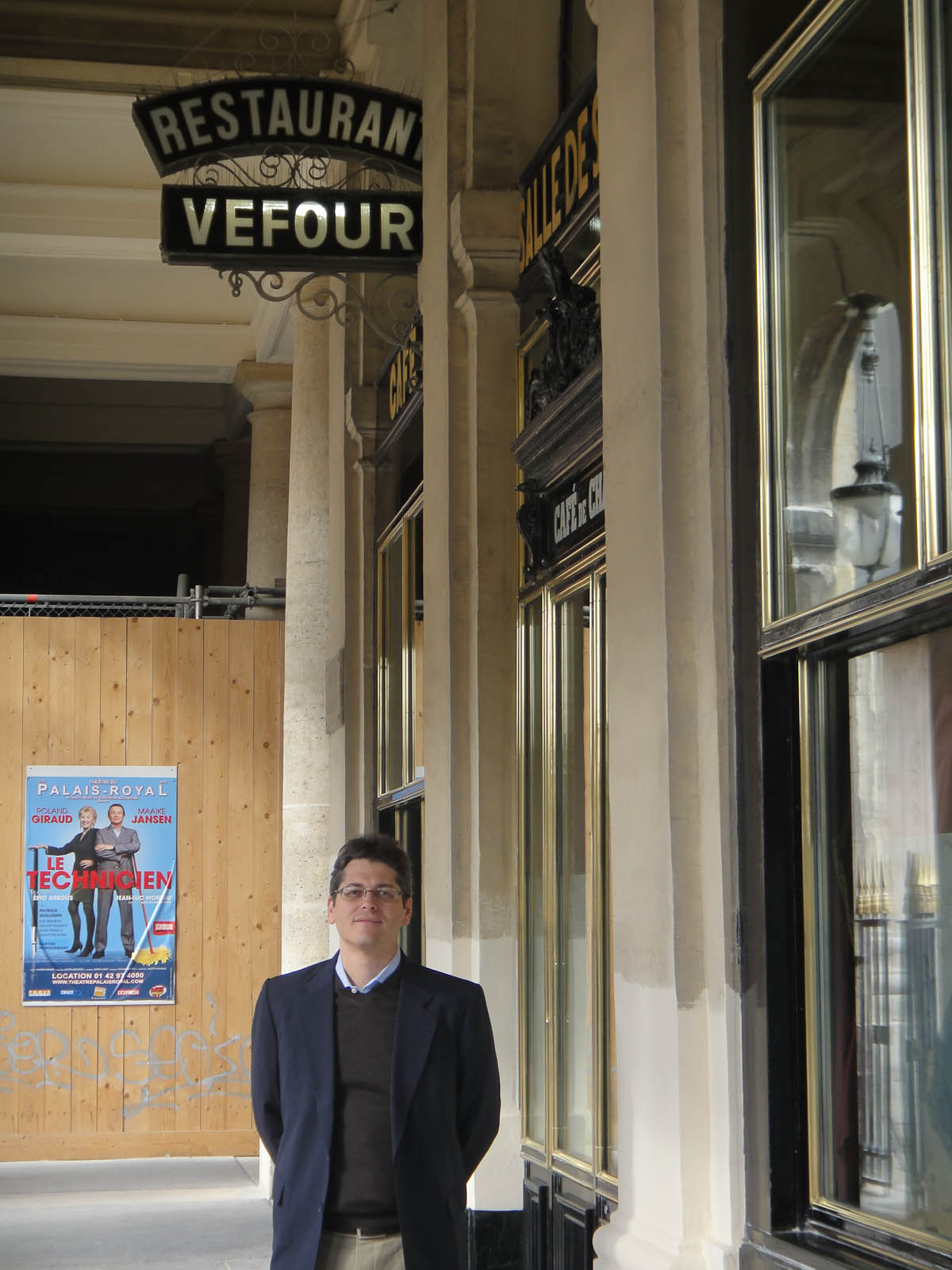
Next chronologically comes Le Grand Vefour; Russ and I went here for lunch to celebrate his birthday at the suggestion of Chris Min. The restaurant first opened in 1784 under the name “le Café de Chartres” and, excepting the war years of 1905-1947, has been in service ever since (it changed ownership and its name in 1820). It is located in the arcade of the Palais Royal, about a fifteen minute walk from where we live. These gardens were originally the private playground of the royals; we were told that the young Louis XIV played here as a child. It is easy to imagine a young prince cavorting among the allies and making mischief with the water fountain.
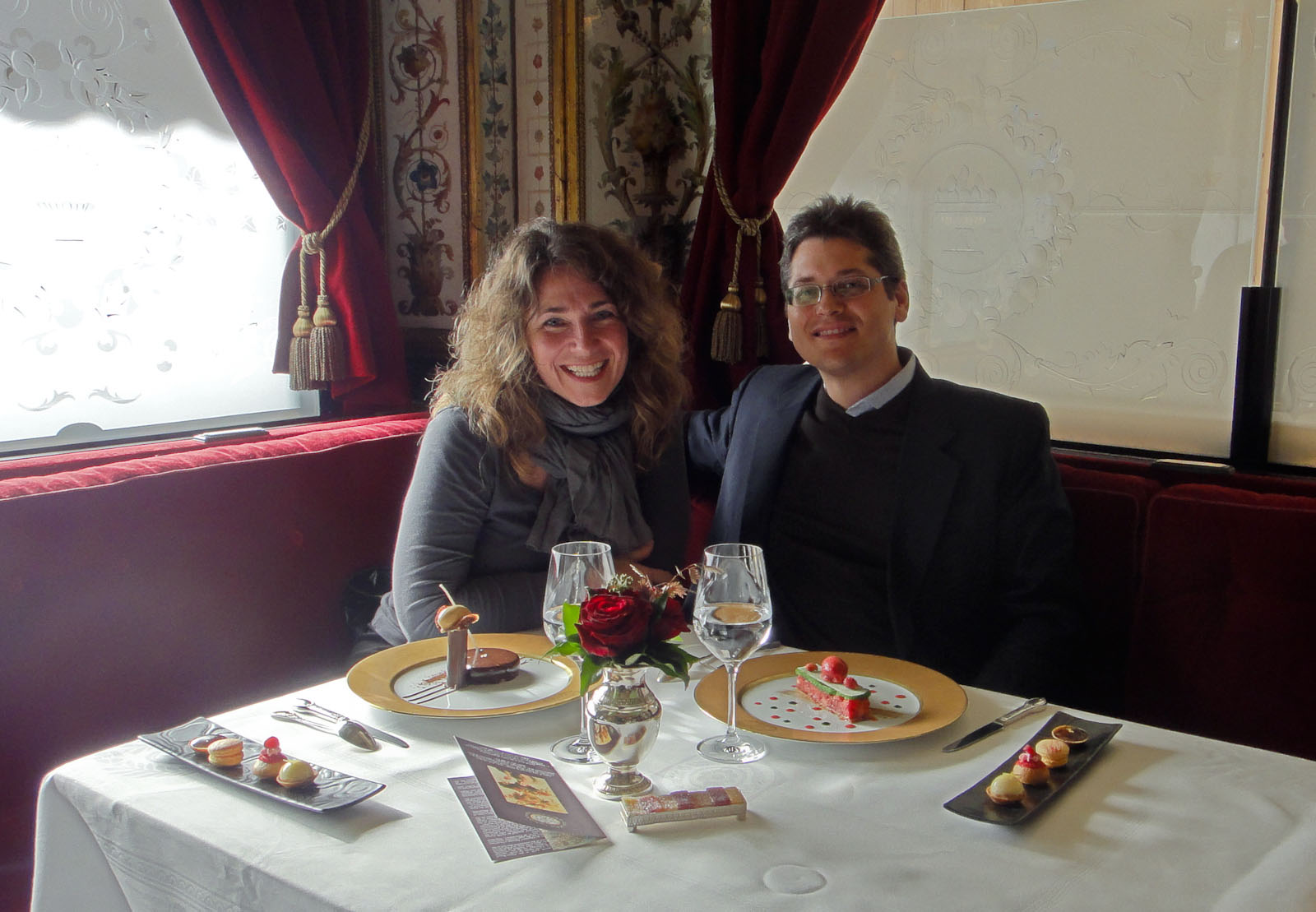
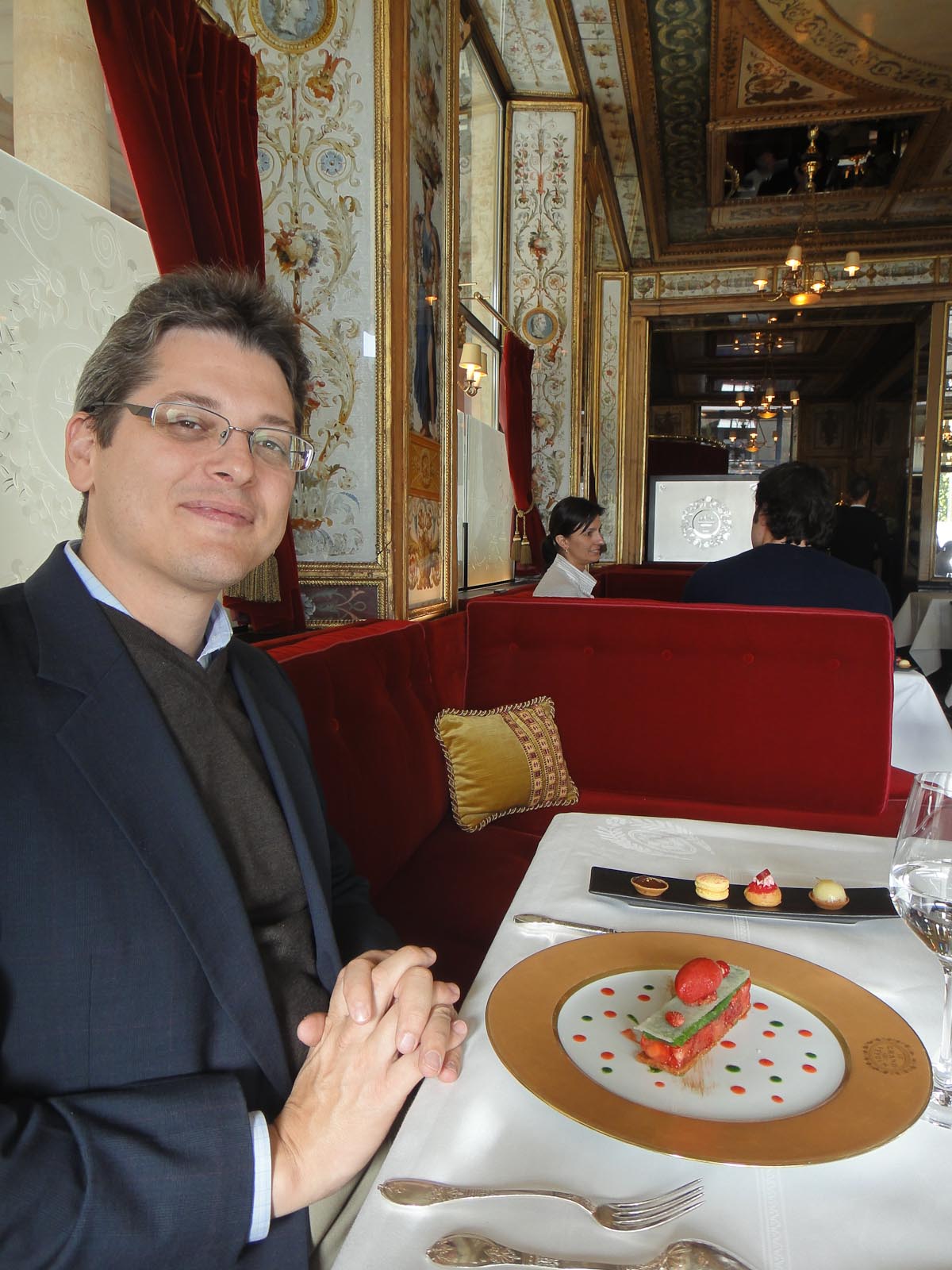
The restaurant itself has some of the most stunning décor we have seen. The walls are covered in mirrors and painted glass, reminiscent of a mini-Versailles; the twenty or so tables are actually booths upholstered in red velvet which line the perimeter of the room. Over the years, the restaurant became “the” place for the intellectual and political elite to dine: Victor Hugo, Georges Sands, Colette, Sartre, Simone de Beauvoir, and Napoleon and Josephine Bonaparte were among the regulars. Today, tiny brass plaques mark each of their seats. When we visited, Russ had Colette’s privileged post. In 1983, the restaurant was officially classified as an historic monument. That same year it was acquired by the current owners, the Tattinger family of French champagne fame. Le Grand Vefour was awarded three Michelin stars in 1953, reduced to two three decades later, and–under the new culinary leadership of chef Guy Martin–went back to three stars in 2000. The latest three-star run was broken in 2006 and today the restaurant is classified as a two-star destination.
While chronologically the youngest of the three restaurants, Taillevent is without doubt an haute cuisine contender [see my earlier posting, Table #4]. Launched in 1946, the restaurant is named after one of France’s earliest chefs, Guillaume Tirel. In 1379 at the behest of the royal court, he wrote Le Viander--one of the earliest bibles of French cuisine. His nickname Taillevent is said to refer to his classic Gaullic profile (apparently, the literal definition of “taillevent” is “wind cutter”). Said by many to be one of the greatest restaurants in Paris, Taillevent’s patrons have included Aristotle Onassis, Maria Callas, and Salvador Dali. Just two years after its launch, Taillevent was awarded its first Michelin star. Six years later, in 1954, it achieved two-star status. Three-star fame came in 1973 and lasted until 2006. Today, missing star notwithstanding, Zagat’s Paris 2010/2011 ranks Taillevent as #1 for best cuisine and #3 for best service out of the 1,022 restaurants reviewed.
While Zagat’s is certainly on the short list of top restaurant review resources, perhaps none is so well known—or revered—as the Guide Michelin. The Michelin Guide has been around for over a century and is widely acknowledged as the pre-eminent restaurant rating system among culinary professionals and dedicated foodies, at least when it comes to Western Europe.
Each of the restaurants we visited has enjoyed three Michelin stars at some point in their illustrious histories. Three stars is a really big deal: in 2010 there were only 85 restaurants in the world with that distinction, 10 in Paris and a total of 24 in all of France (interestingly, the greatest number of three star restaurants is now in Tokyo). In order to get a sense for the magnitude of what it really means to be “three star,” I decided to learn a little bit about Michelin and their ranking system.
The Guide was originally launched to encourage driving, and, consequently, sell cars equipped with Michelin tires. It was the brainchild of engineers André and Édourd Michelin. In 1895, the two brothers came up with a design for a pneumatic tire and the Michelin man was born.
The first edition was published in 1900 (three years before Ford Motor Company was incorporated and eight years before the launch of the Model T). It was a 500+ page tourist guide covering all of the towns of France, the driving distance between them, and tips for where to stay and dine along the way. It wasn’t until 1933 that the guide introduced its system of stars, with one star denoting “a very good restaurant in its class”; two stars “excellent cooking, worth a detour”; and three stars “exceptional cuisine, worth a special journey.”
The Guide has never accepted advertising and has therefore retained independence and objectivity since its inception. It also places a tremendous amount of importance on the anonymity of its inspectors. Michelin claims that its top executives don’t even know who their inspectors are, all the better to retain their secrecy.
I began to fantasize: could I ever become a Michelin reviewer? What would life as a reviewer of the world’s best restaurants be like?
The short answer is, no way and not as glamorous as it might seem.
No amateur foodie—no matter how enthusiastic an eater he or she might be—would ever be considered for the post of Michelin inspector. Serious candidates must have a degree in hospitality, hotel management, or cooking. Inspectors must also agree to maintain the utmost confidentiality and may never reveal their true profession, even to spouses or parents who may be tempted to brag just a little. The average Michelin reviewer drives 18,000 miles per year and covers 800 restaurants: that translates into one lunch and one dinner every day, 200 days per year (it sounds a little like a forced food march to me). Inspectors most often dine alone (exile for extroverts) and are required to eat everything on their plate (not so bad). Written reviews, which can take up to three hours each, must be completed immediately following the meal so that no detail is lost. No time for a food coma.
Despite the reality of the job requirements, Michelin apparently received more than 3500 applications for its last open position, a reviewer for New York. So, while that would certainly not be the life for me, Michelin has no lack of interested and eminently more qualified candidates.
Which leaves just one last question: namely, if you could only eat at one of these three restaurants, which one should you pick?
My very personal, highly-subjective opinion is Le Grand Vefour. While the caliber of the cuisine and service at Taillevent are comparable, or perhaps even ever so slightly higher, Le Grand Vefour’s history and extraordinary décor make it a feast for the eyes as well as the palate. Taken together with a sip or two of the proprietor’s champagne, you can almost imagine yourself dining alongside the Bourbons. Now that is a dining experience worth driving out of your way for.
Below... some pictures from Russ' birthday and our celebration at the Grand Vefour.


Error thrown
Call to undefined function ereg()